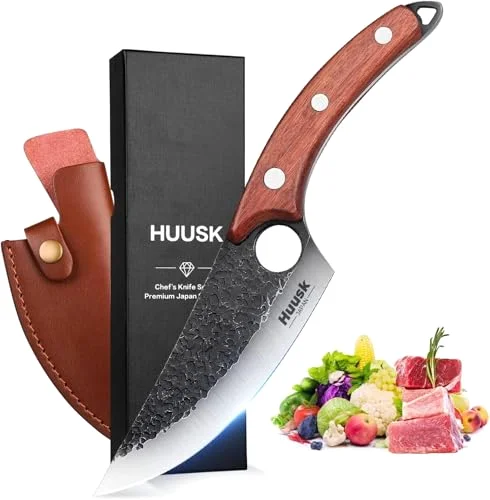
Viking knives with a sheath
Hand Forged Viking Knife, Brown
- Sheath included
- Handle: Brown
4.4 · 2,434 ratings
$27.98
01Forged blades for a working kitchen
A blunt edge does not slice a tomato, it squashes one, and the force you add to make up the difference is the force that slips. Every Huusk blade is ground to fall through the work, and every card here prints the blade length, the steel and the piece count so you can pick by the figure rather than by the photograph.
Two hundred and thirty-three Huusk knives, from an $11.69 pair of shears to a fourteen-piece block set, with the blade length and the steel printed on every card.
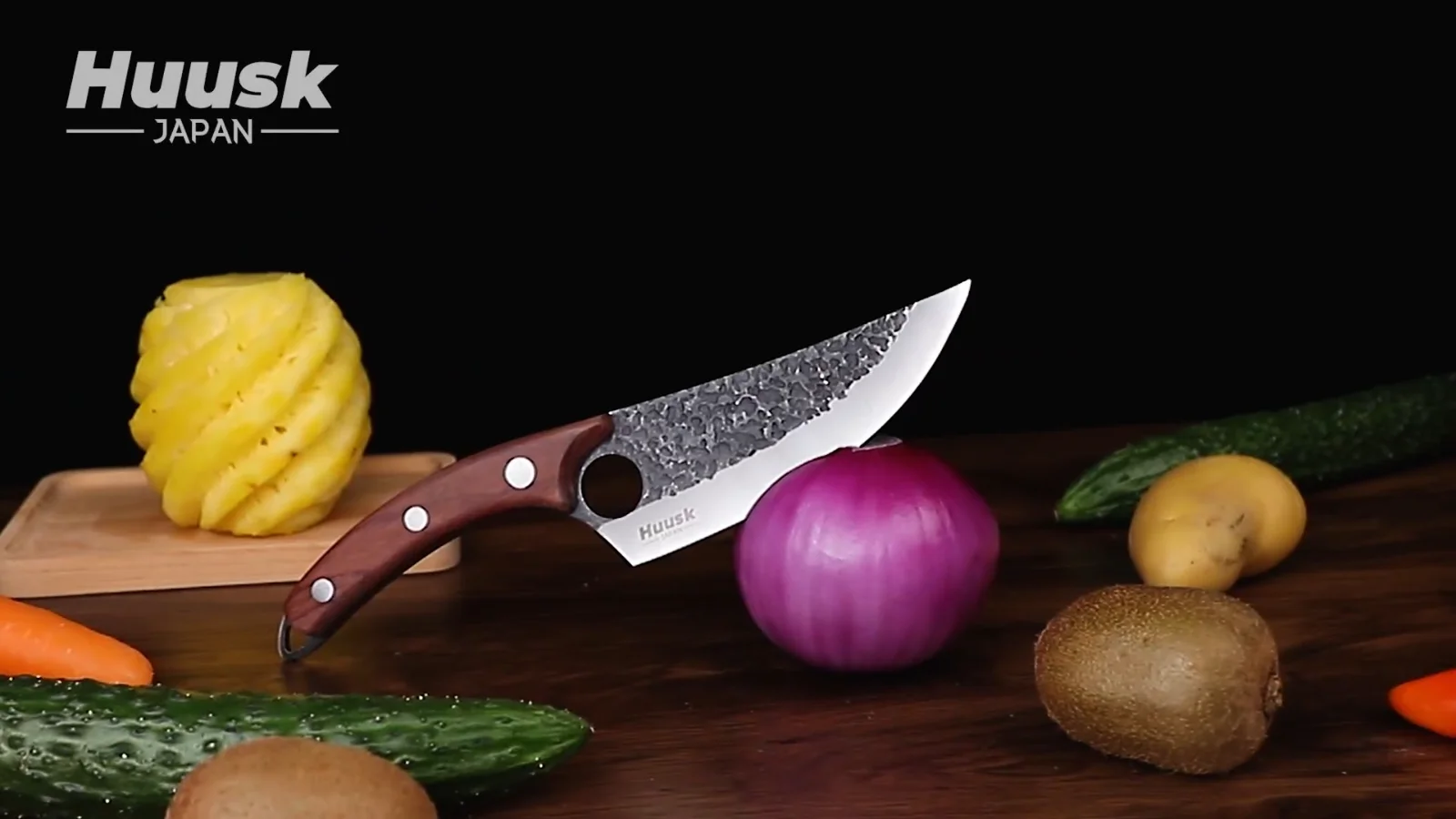
Huusk Hand Forged Viking Knife, BrownSheath included · $27.98
02Start with the job
A gyuto and a boning knife look like the same object until you use both. One is a flat-ish edge you rock through onions. The other is a narrow blade you steer around a joint. Pick the job and the shelf sorts itself out.
Nine shelves, one question asked nine ways, and every knife on all of them belongs to the Huusk selection.
03What people buy first
The five with the deepest pools of customer ratings behind them: the everyday chef blade, the forged shape the brand is known for, and the cleavers that take a chicken apart. Between them they cover most of what a week on a board asks for.
Viking knives with a sheath
4.4 · 2,434 ratings
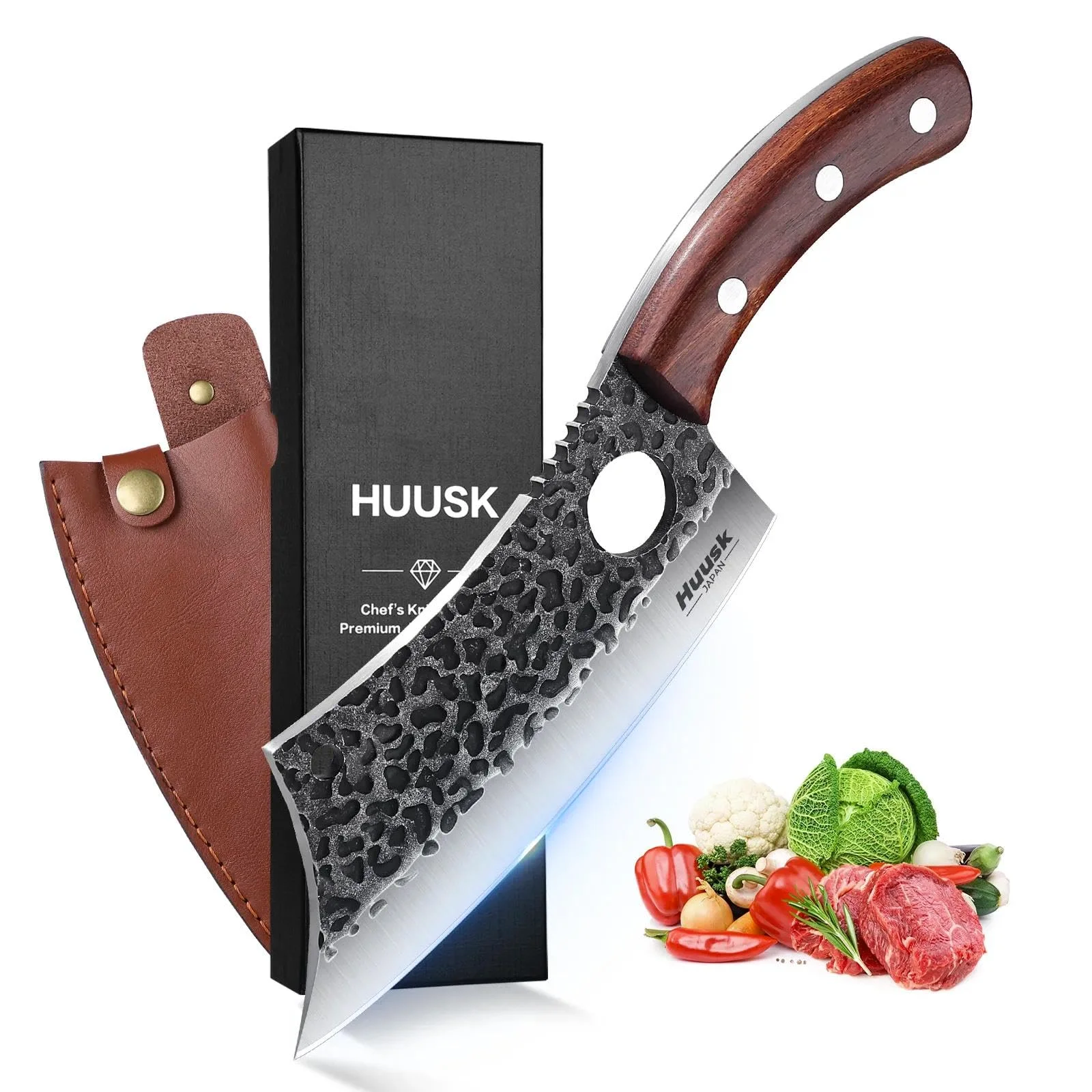
Meat cleavers
4.7 · 2,312 ratings
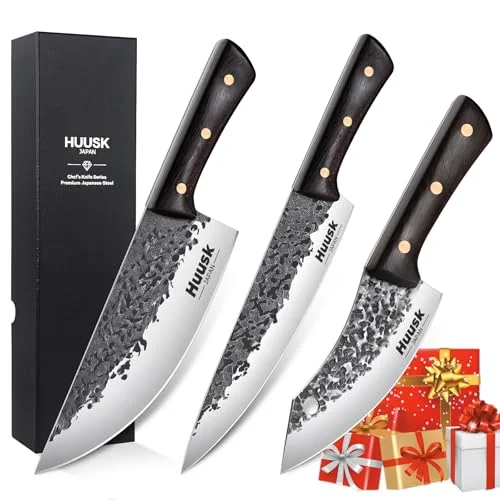
Butcher knives
4.5 · 1,794 ratings
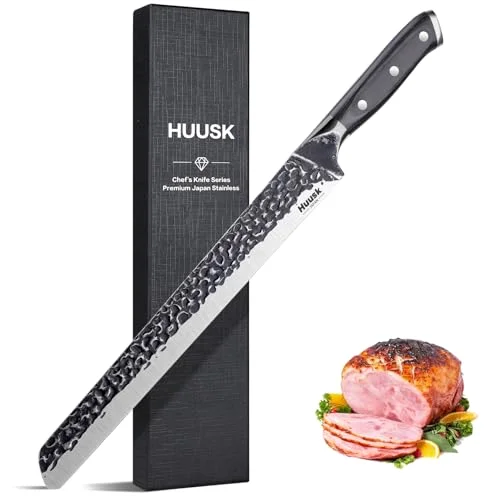
Slicing, carving & bread
4.6 · 1,354 ratings
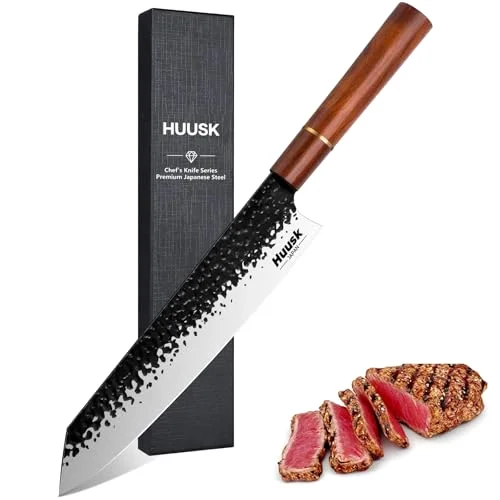
Gyuto & kiritsuke
4.5 · 603 ratings
04Before you pick one
Almost every returned kitchen knife is the right knife bought for the wrong hand or the wrong board. Six things to settle first, none of which need you to know anything about steel.
Lay a tape across the board you actually use. A blade longer than about two thirds of that board has nowhere to travel, and you end up cutting at an angle. Twelve inches of board takes a seven-inch blade comfortably. Fifteen inches takes an eight or a nine.
Most people hold a knife by the handle. Most people who cook a lot pinch the blade just in front of the bolster. If you pinch, you want a flat spine and a tang you can feel. If you do not, a rounded resin handle will be more comfortable than ebony.
If you break down a chicken most weeks, a cleaver or a Serbian blade belongs in the drawer and your chef knife stops meeting bone. If you never do, skip the heavy shelf entirely and put the money into one good eight-inch blade.
High carbon takes a better edge and rusts if it sits wet. If knives in your house get left in the rack overnight, buy the stainless or VG-10 version and be honest about it. A rusted blade you resent is worse than a stainless one you use.
Divide the set price by the pieces and compare it against the singles you would actually buy. Every card on this site prints that figure. A fourteen-piece set is a bargain if you use nine of them and an expensive block if you use three.
A drawer is where a forged Huusk edge dies, and a spoon is usually what kills it. Sixty-nine of the knives here ship with a sheath. If the one you want does not, plan for a magnetic bar or a block before it arrives rather than after the first chip.
05Where the blades come from
Huusk began with a single hand forged blade and an ordinary grievance: the knife in the drawer needed pressure, and pressure is what turns a slip into a cut.
The first answer was not a clever one. Instead of a prettier handle, the work went into the edge, thinner behind the bevel so the steel parts the food instead of wedging it apart, and into the tang, so the weight sits where your hand is rather than out at the tip. That order has not changed. The face of a knife is what you look at in a photograph. The geometry behind the edge is what the knife actually is.
The catalogue widened one complaint at a time. A chef knife that cannot get through a chicken back is the Sunday version of the problem. A paring knife too big for the hand is the weekday version. A boning knife with no flex is the version that ruins a fillet. Same question, nine shelves, and the answer in each case is a shape and a grind rather than a slogan.
What that means in practice is unglamorous. A hammered flat has to release a wet potato without leaving dimples deep enough to trap food. A full tang has to run the whole length of the handle so the join never becomes a hinge. A leather sheath has to be tight enough to hold a blade upside down and loose enough that you are not pulling against friction with your palm over the edge. None of those are breakthroughs. They are the parts of the job that get skipped.
Today the Huusk range runs from an $11.69 pair of kitchen shears to a fourteen-piece block set, and the same question sits under all of it: does this blade do the work, or does it make you do the work?
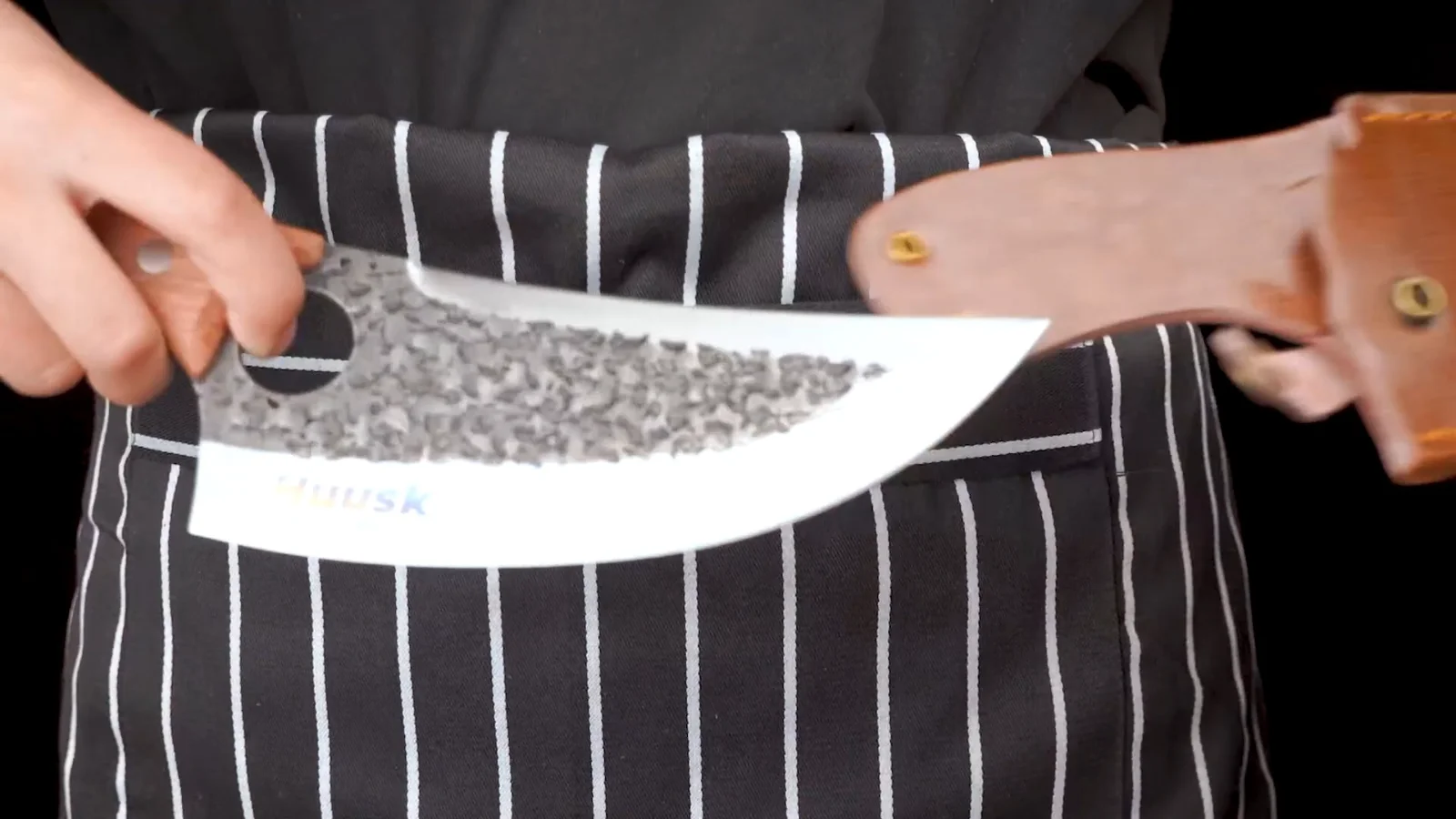
A full tang is the same piece of steel as the edge, running the whole length of the handle underneath the scales and pinned through it. It is why a forged knife balances just in front of your fingers rather than out at the tip, and why the join between blade and handle never becomes a hinge. No photograph shows it, and it is most of what separates these from a knife of the same shape at half the price.
A billet goes into the fire until the steel is soft enough to move but not so hot that the grain coarsens. Everything after this is decided in the next two minutes.
The blank is drawn out under the hammer rather than cut from a sheet. That is where the hammered flat on a Huusk knife comes from: it is the record of the blows, not a texture applied afterwards.
The hot blade goes into oil or water and the structure of the steel locks. Too fast and it cracks. Too slow and it never gets hard. This is the step that decides whether an edge will hold.
The blade is reheated gently to take the brittleness back out. A knife that skips this chips on a chicken bone. A knife over-tempered goes blunt in a fortnight.
The bevel is ground, the edge is put on, and the tang is fitted into ebony, rosewood, pakkawood or resin. Sixty-nine of the blades here then go into a sheath.
06The heavy end
Every Huusk blade on this row has a job you can name. Cleavers go through a chicken back. Boning knives go around it. A fillet knife takes the skin off without taking the flesh with it.
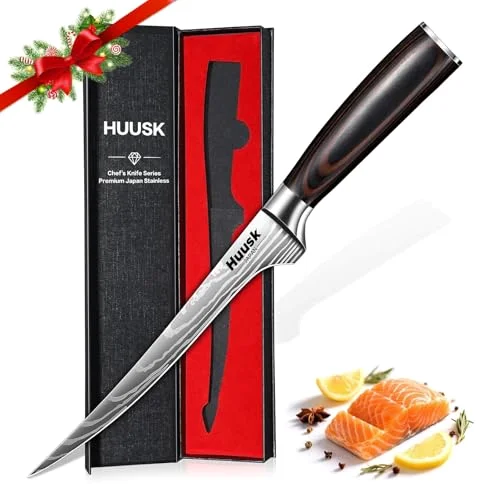
Fillet knives for fish
4.4 · 2,434 ratings
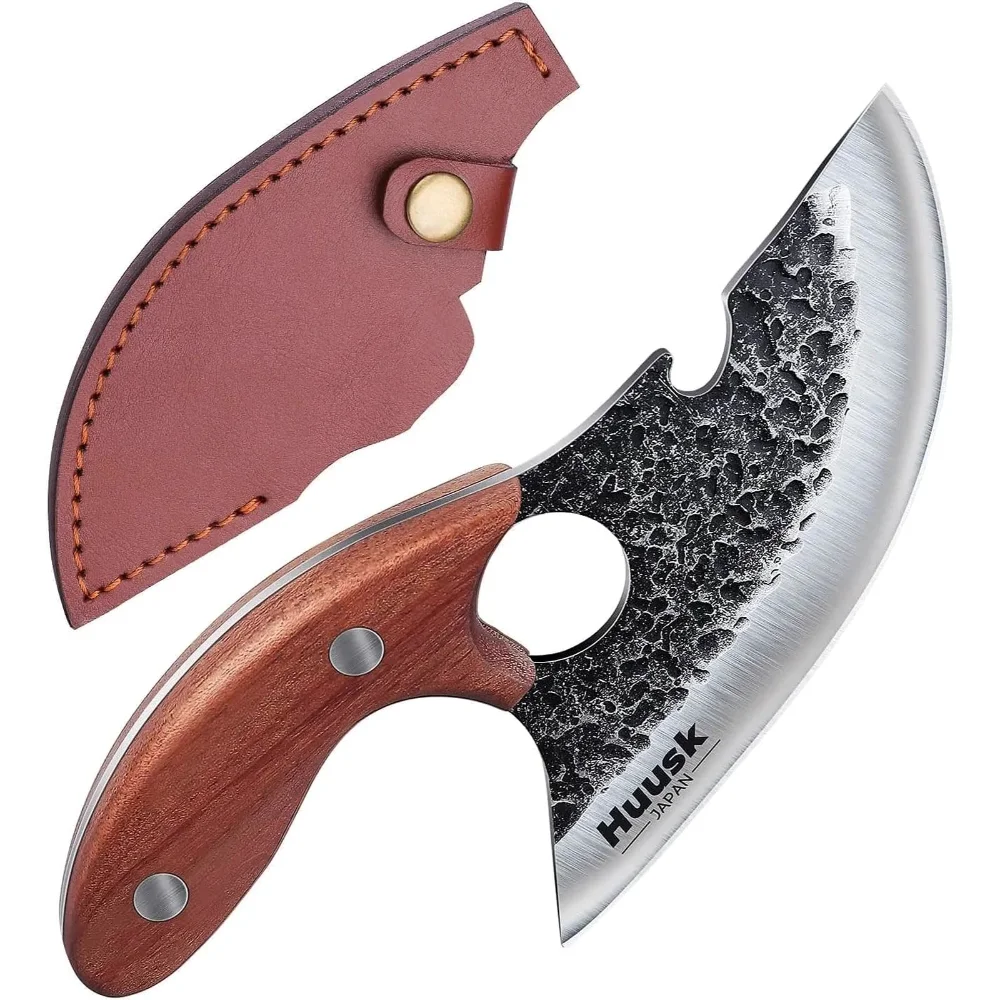
Ulu knives
4.5 · 2,378 ratings
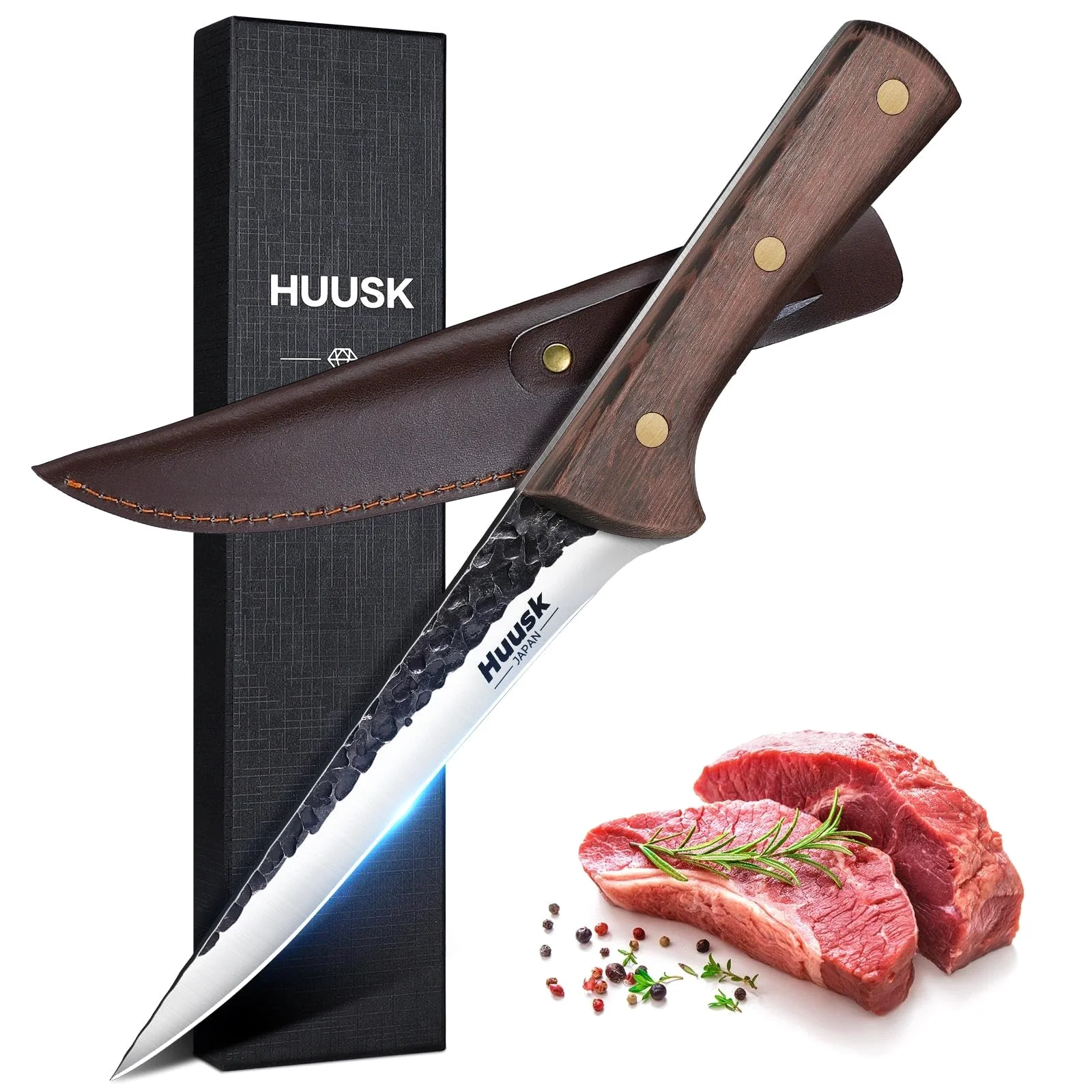
Fillet knives for fish
4.6 · 1,354 ratings
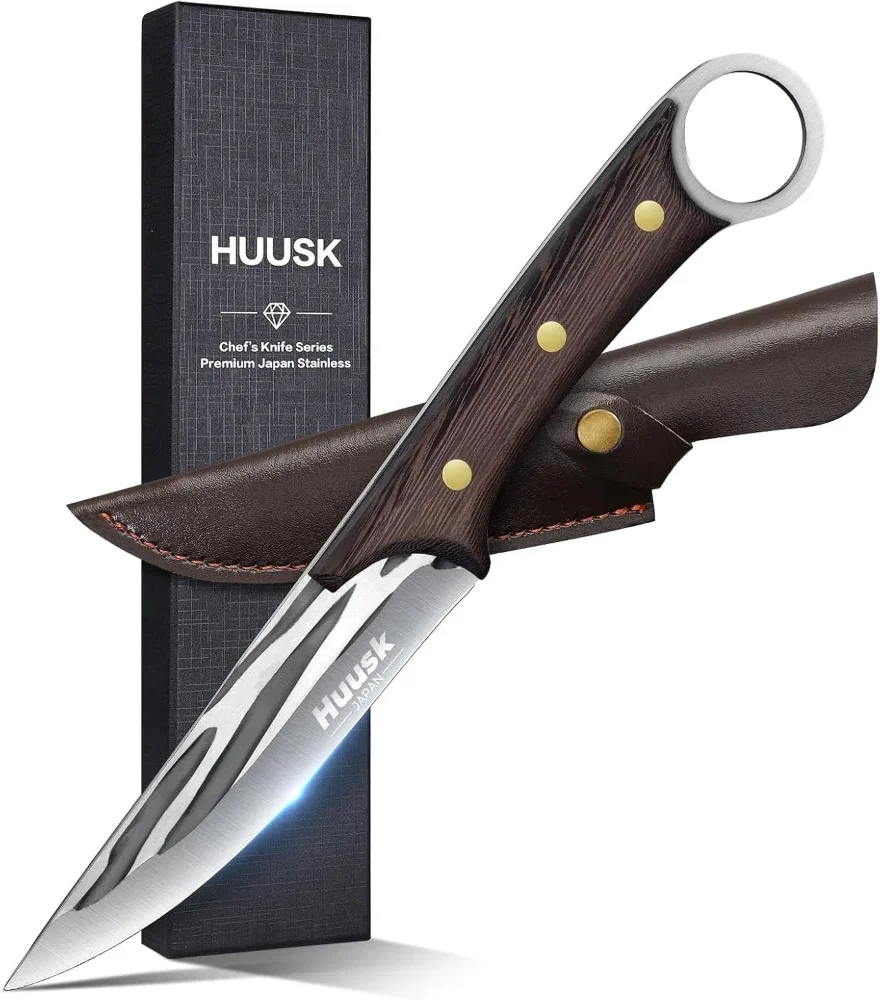
Boning knives
4.5 · 1,289 ratings
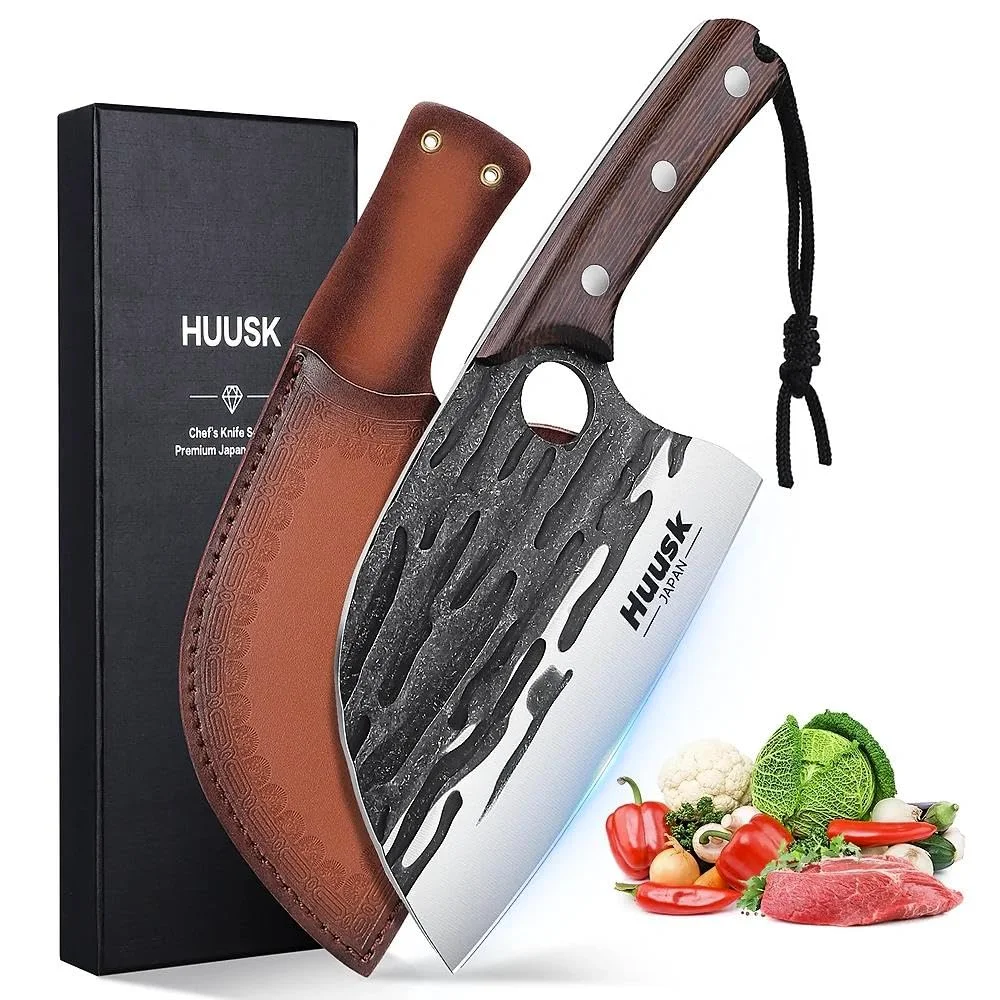
Meat cleavers
4.7 · 1,006 ratings
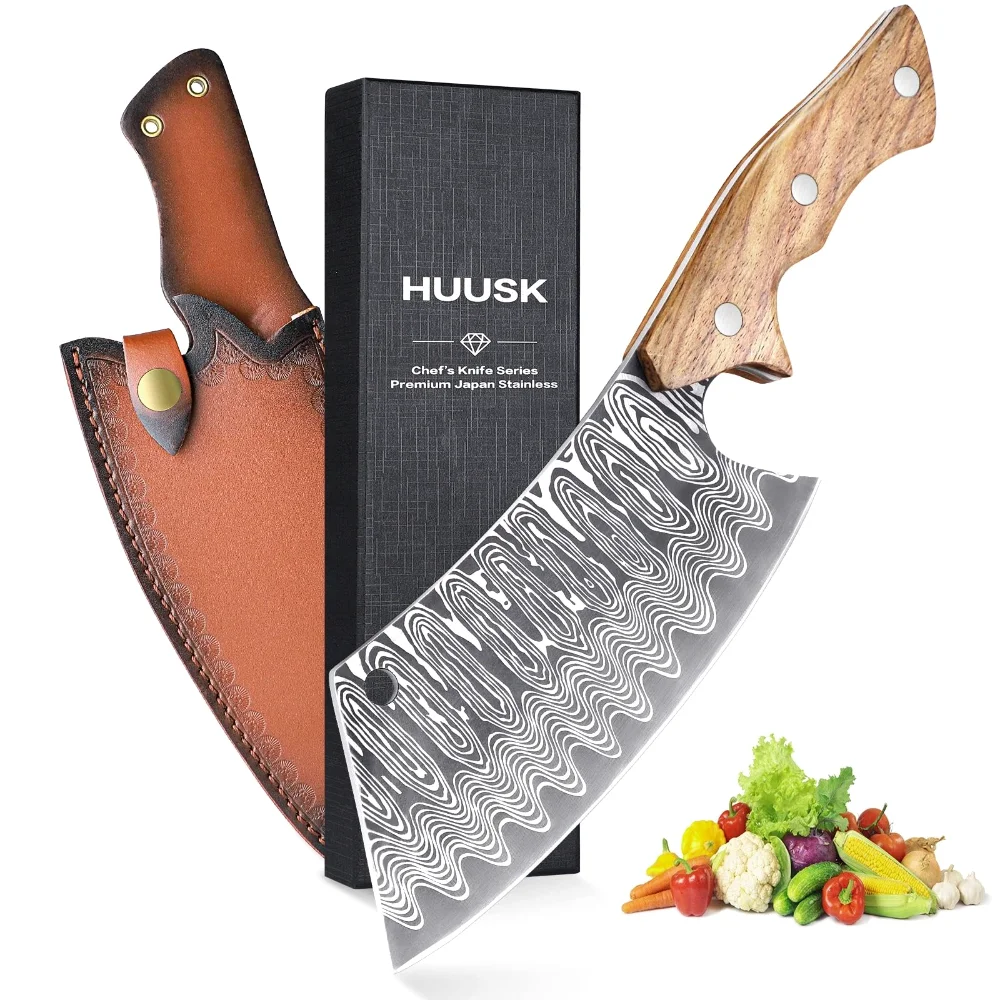
Meat cleavers
4.6 · 963 ratings
All 58 butcher knives and cleaversAll 23 boning and fillet knives
07On the board
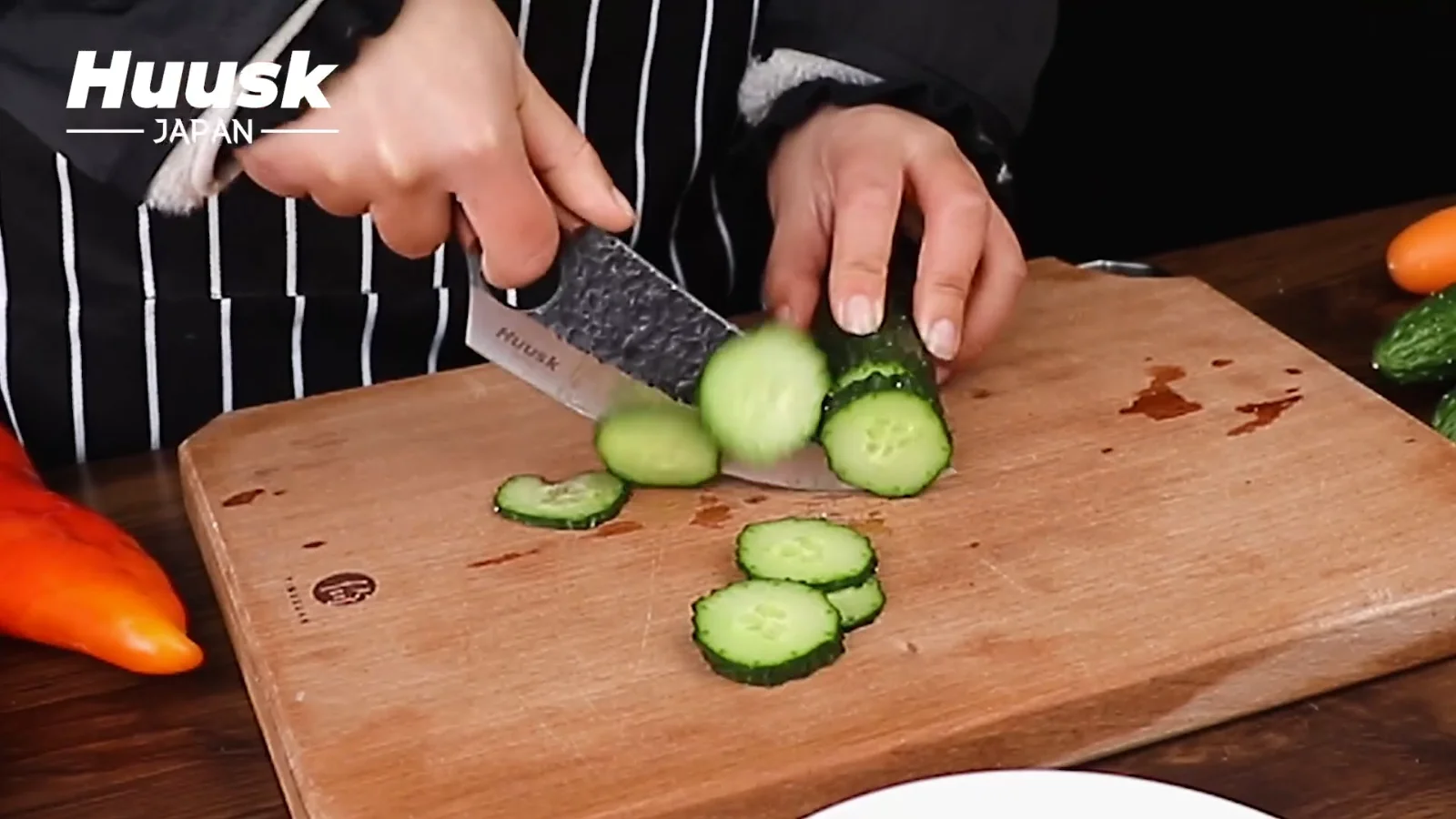
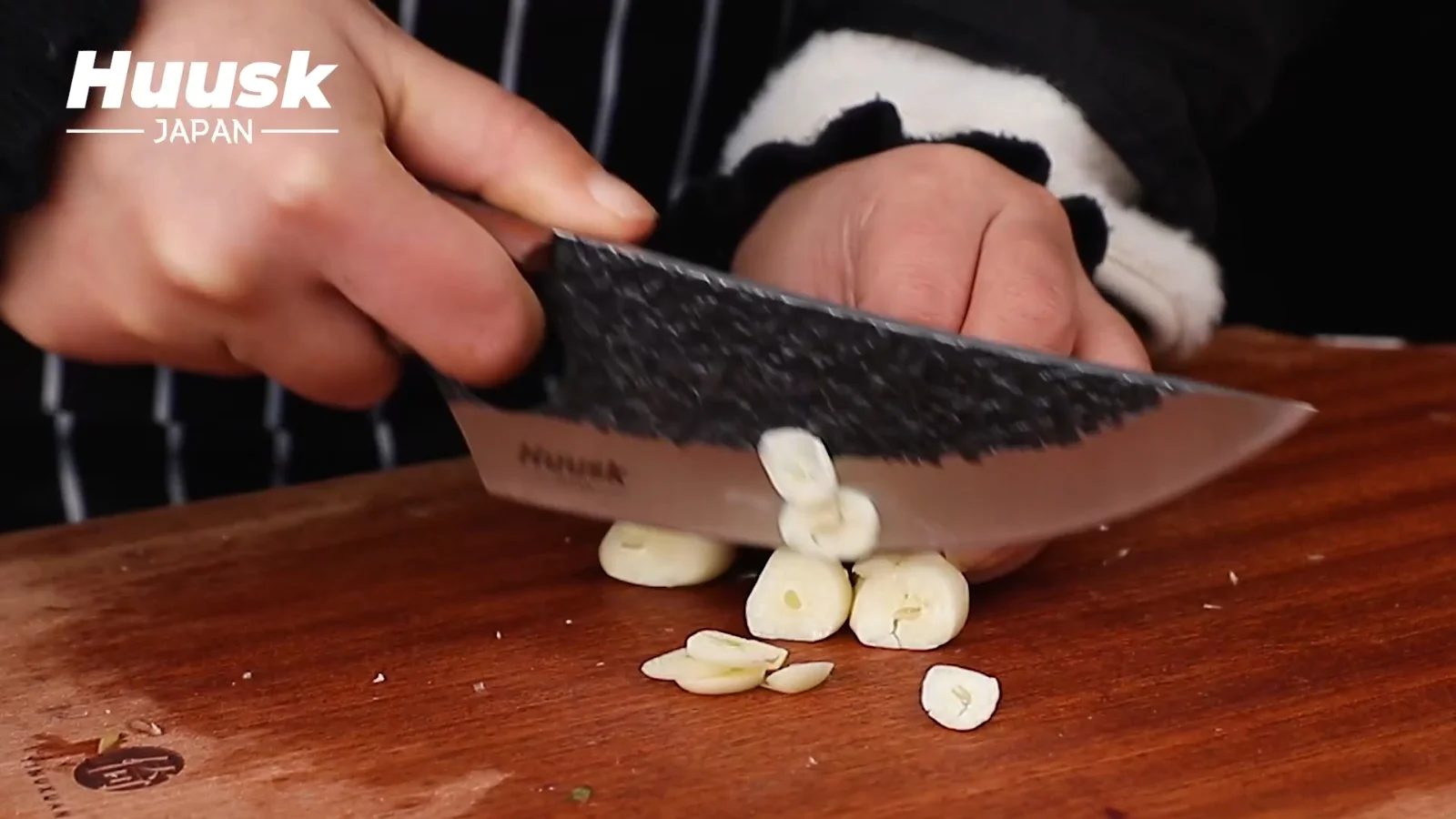
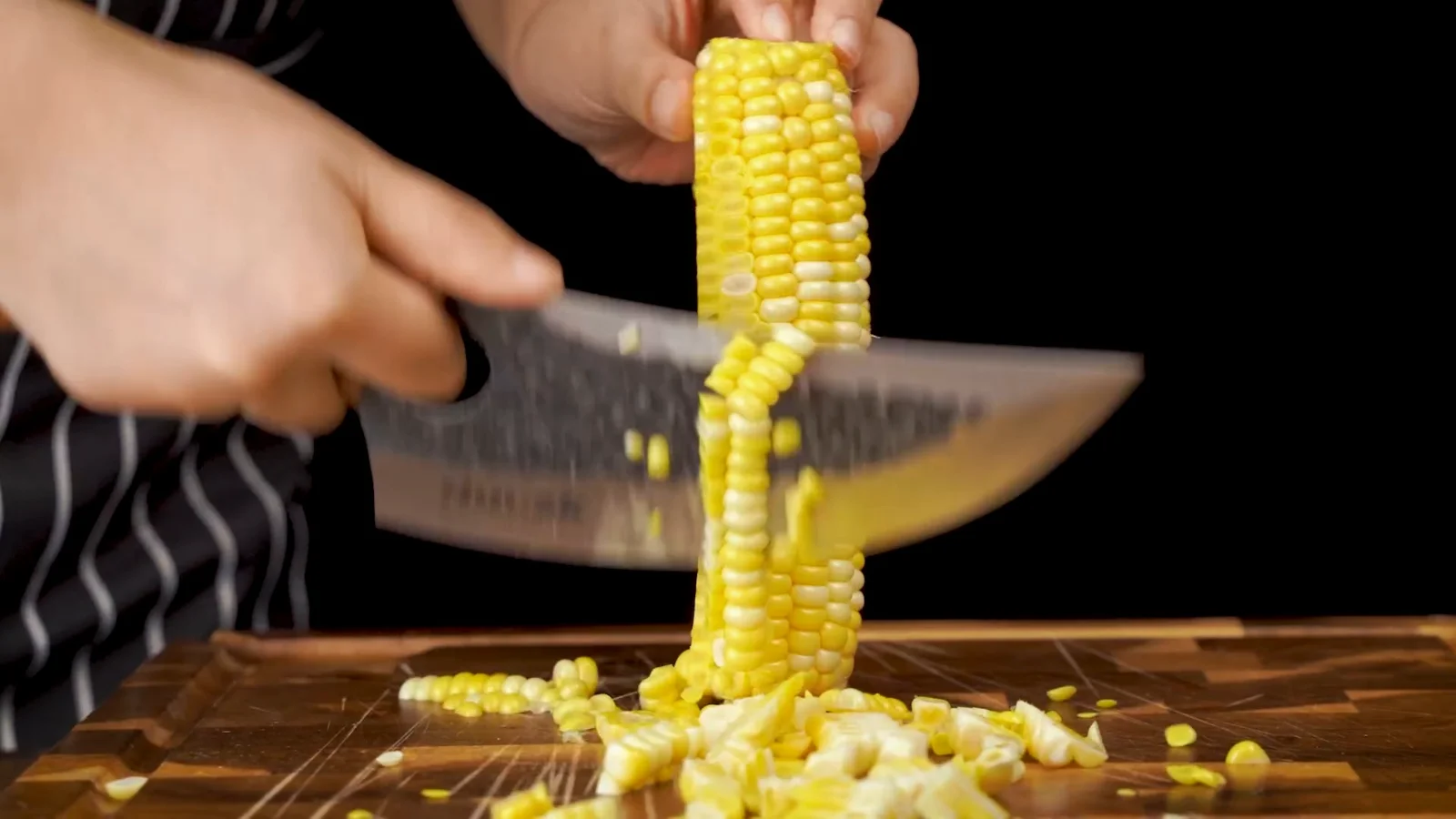
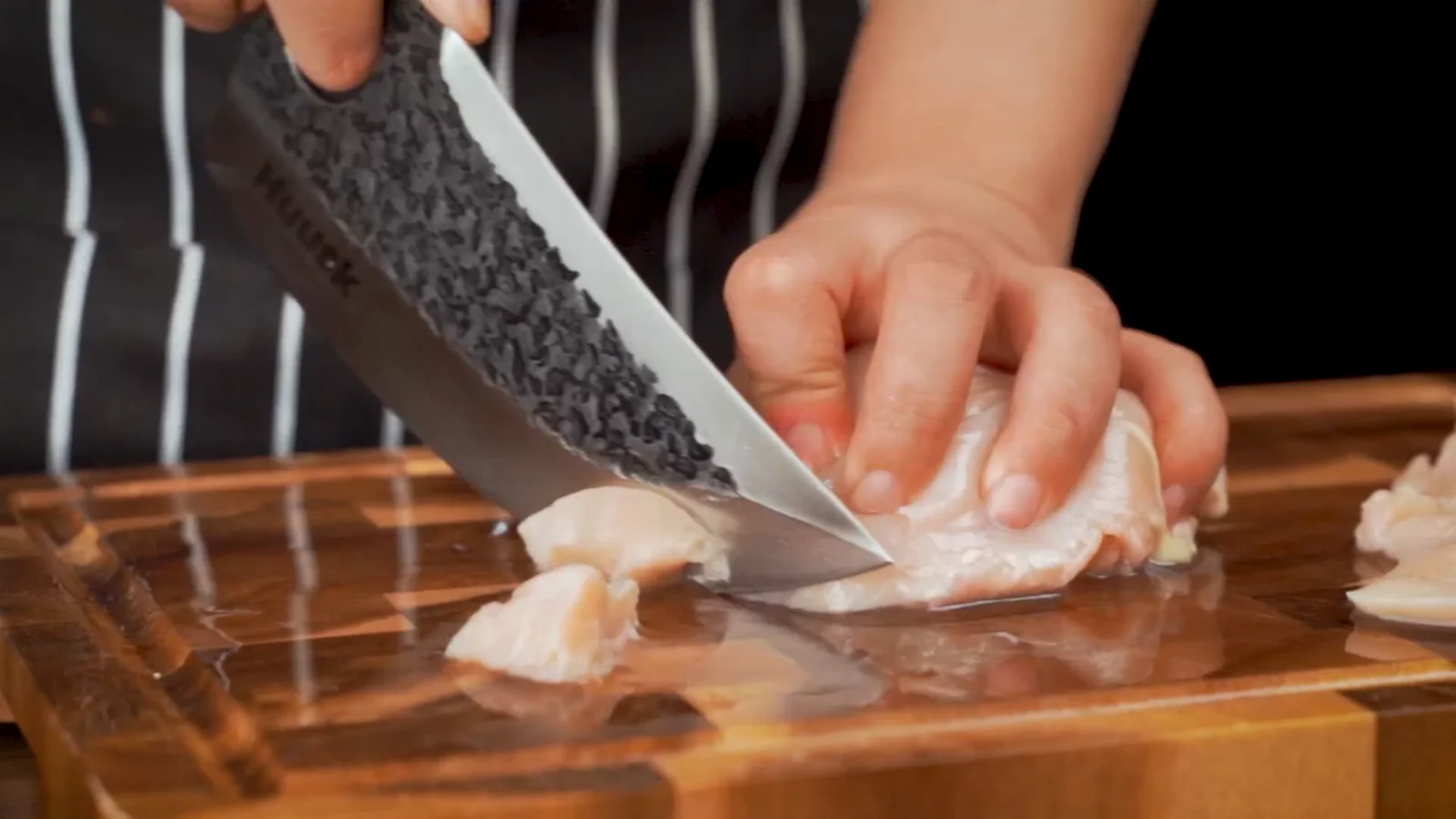
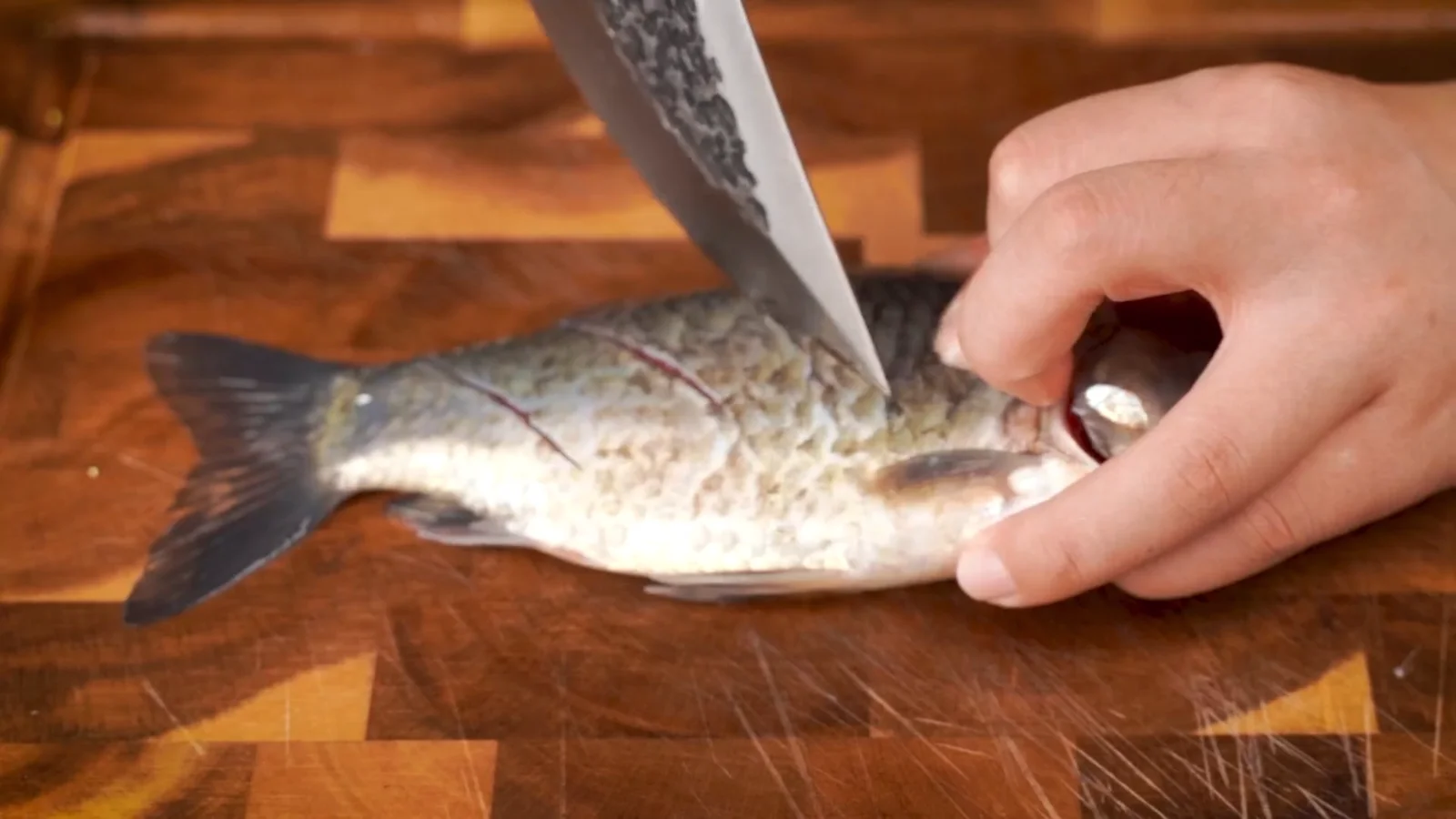
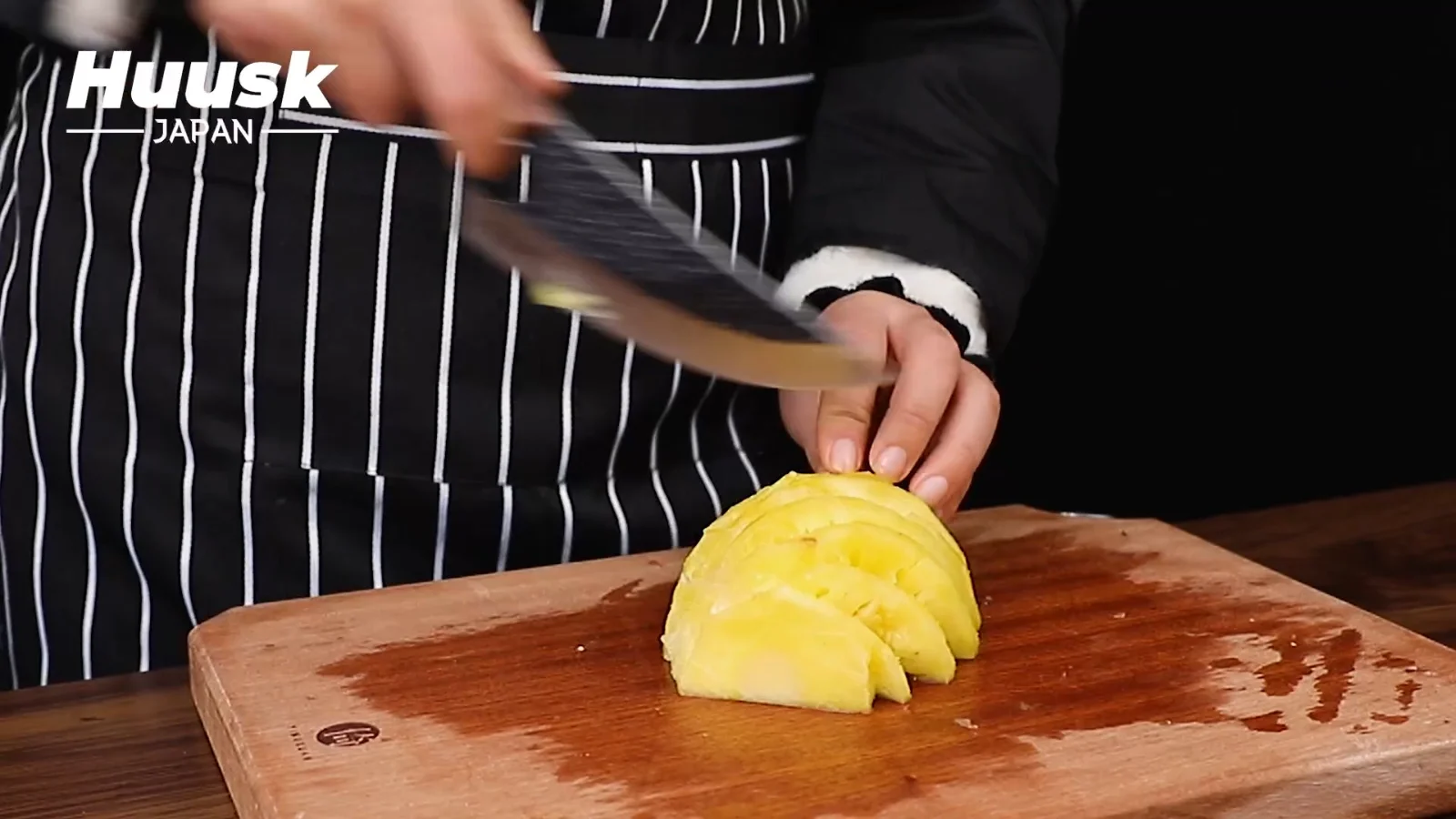
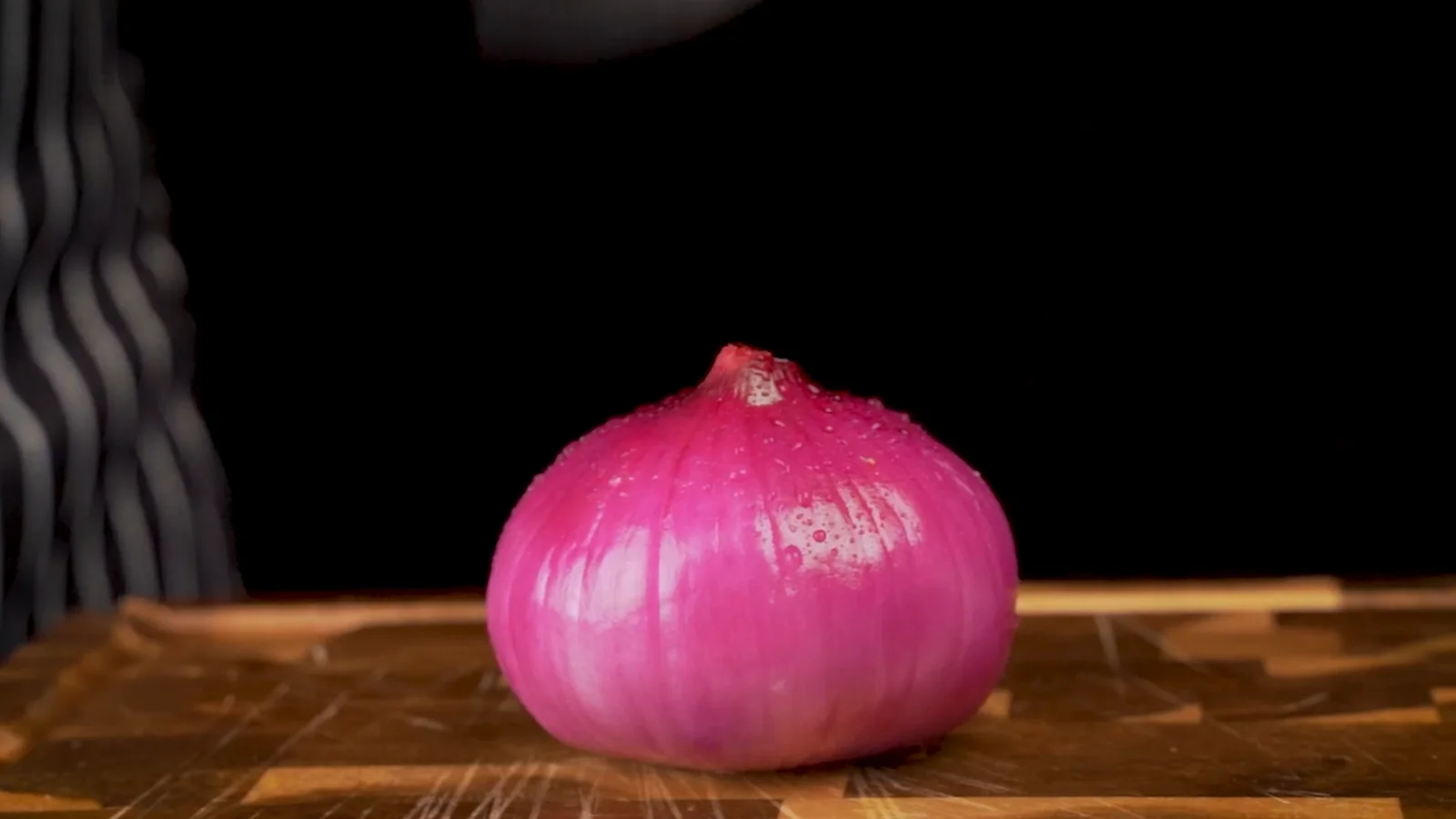
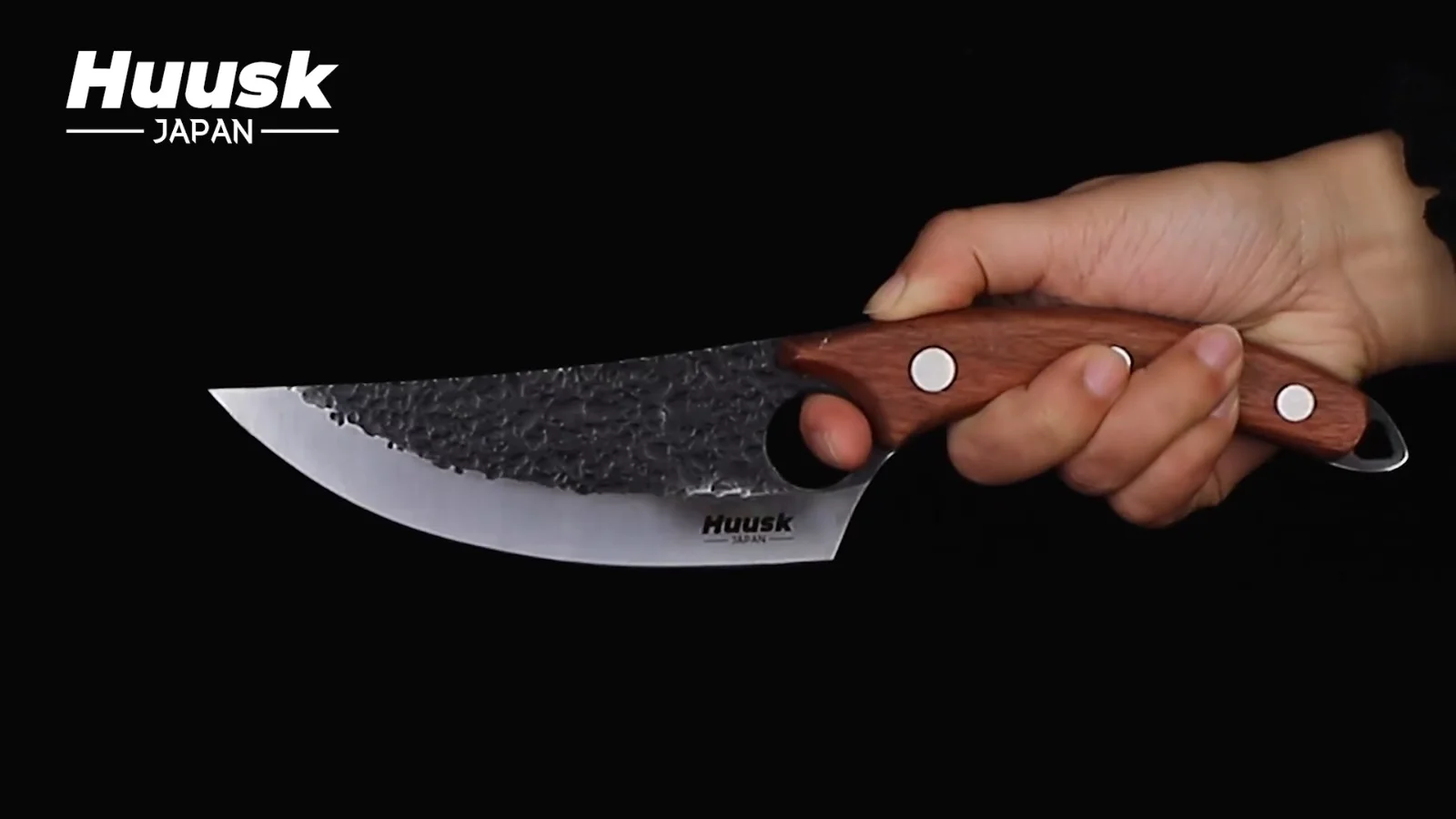
Huusk blades out of the box, with sheaths, blocks and rolls beside them, close enough to see the hammer marks on the flat and the join where the tang goes into the handle.
08What the blade is made of
Almost every disappointing knife in the world is a good steel asked to do the wrong job. A hard, high-carbon edge is wonderful on vegetables and unforgiving on frozen chicken. A soft stainless one forgives everything and needs the rod more often. Here is the short honest version of which is which.
Takes the keenest edge in this catalogue and keeps it longest. It also rusts if you leave it wet, so it wants drying the moment it comes out of the sink. This is the steel behind most of the hand forged blades here.
Layers of two steels forge-welded and folded, then etched so the boundary shows. The pattern is real rather than printed, and the working edge is the core inside it. Twelve knives on this site carry it.
A Japanese stainless core clad in softer steel. It holds an edge close to a carbon blade and forgives a night in the drying rack, so it turns up on the Huusk gyuto and the kiritsuke.
The steel on the shears, the steak sets and most of the block sets. It gives up its edge sooner than the others and it does not care what you do to it, which for a table knife is exactly the right trade.
| Steel | Where it belongs | How to look after it | Where it fails |
|---|---|---|---|
| High carbon | Chef, santoku, nakiri, slicing | Dry it the minute it leaves the water. A wipe of oil if it sits unused | Left wet overnight, or in a dishwasher |
| Damascus pattern | Chef and santoku, where the edge does fine work | Hand wash, dry, hone on a rod between sharpenings | Prying and twisting: the harder the core, the less it bends |
| VG-10 core | Gyuto, kiritsuke, the eight-inch everyday blade | Hand wash and dry. It tolerates a delay you should not take | Chopping through bone, which is a cleaver’s job |
| ATS-34 and other tool steels | Butcher and breaking knives | Dry, and keep the edge off the steel of a sink | Fine slicing: the grind is built for force, not finesse |
| Plain stainless | Shears, steak sets, block sets | Hand wash. A rod every few weeks does more than sharpening | Long sessions where a keen edge is the point |
Nothing in the Huusk way is asked to work in two jobs at once, so the steel sits on the card next to the blade length.
09Boxed and ready to give
A Huusk set is a decision you only make once, so the useful figure is what each blade in it works out at. Every card below prints the piece count and the price per knife next to it.
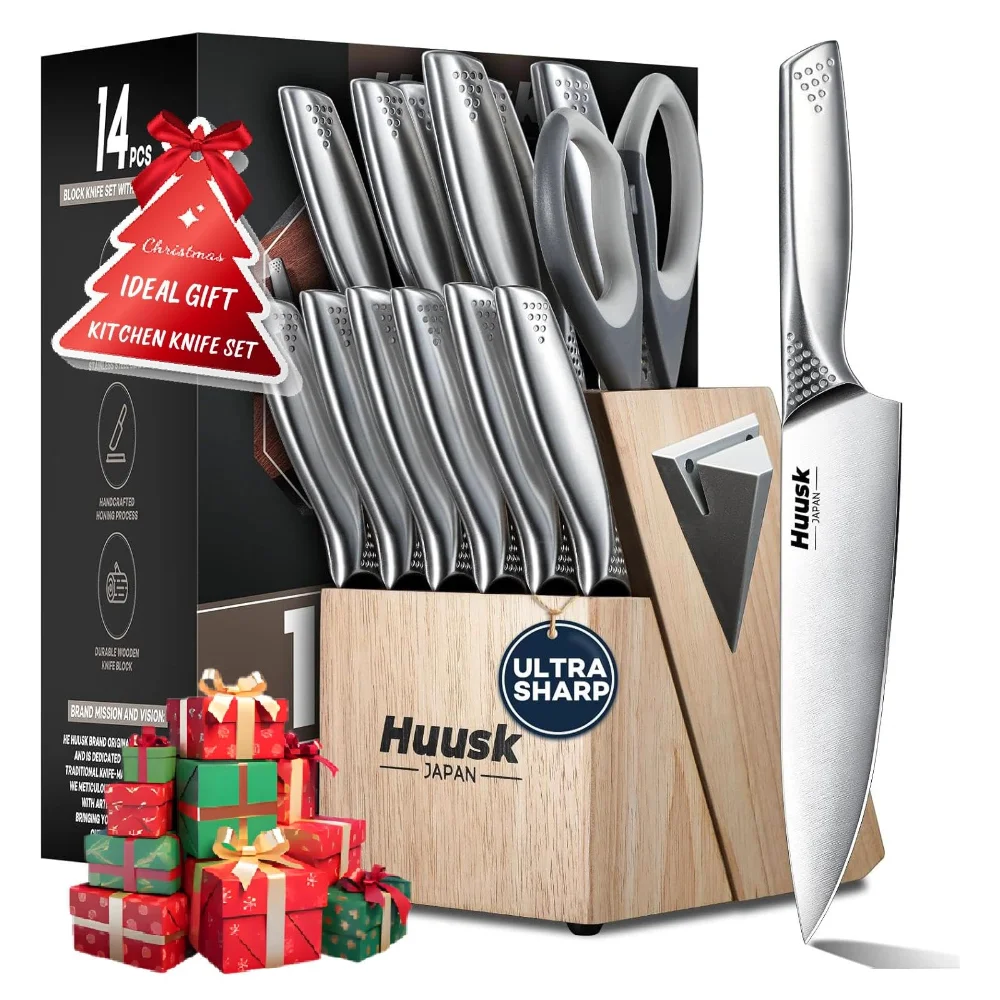
Knife sets with a block
4.4 · 2,434 ratings
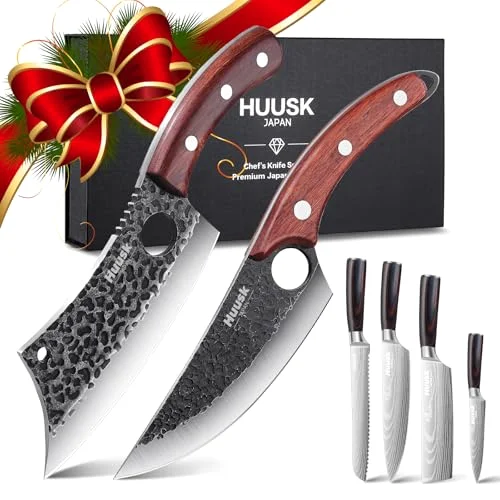
Gift bundles & boxes
4.7 · 2,312 ratings
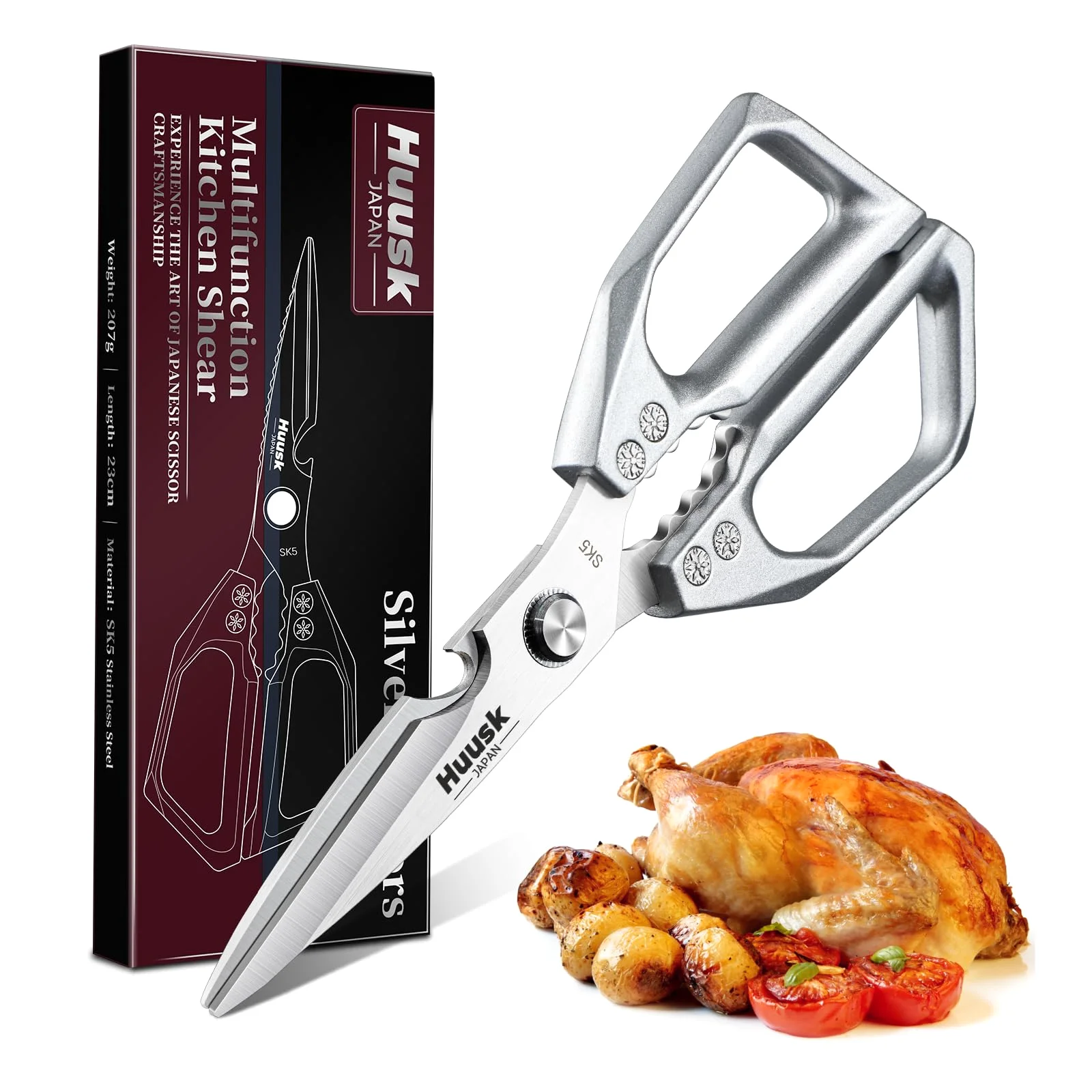
All purpose kitchen shears
4.6 · 1,911 ratings
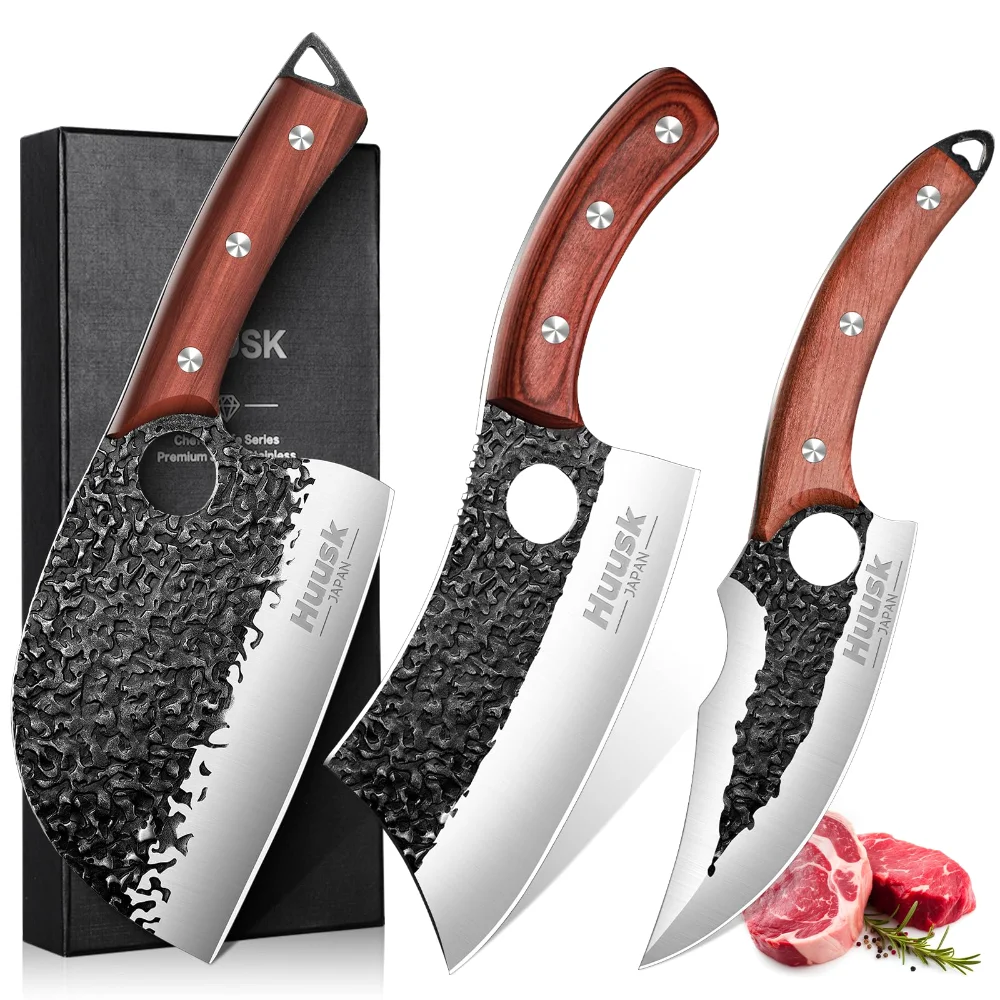
Japanese kitchen knife sets
4.7 · 886 ratings
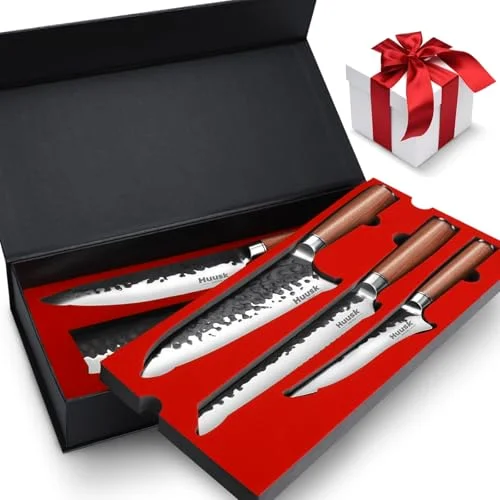
Gift bundles & boxes
4.5 · 806 ratings
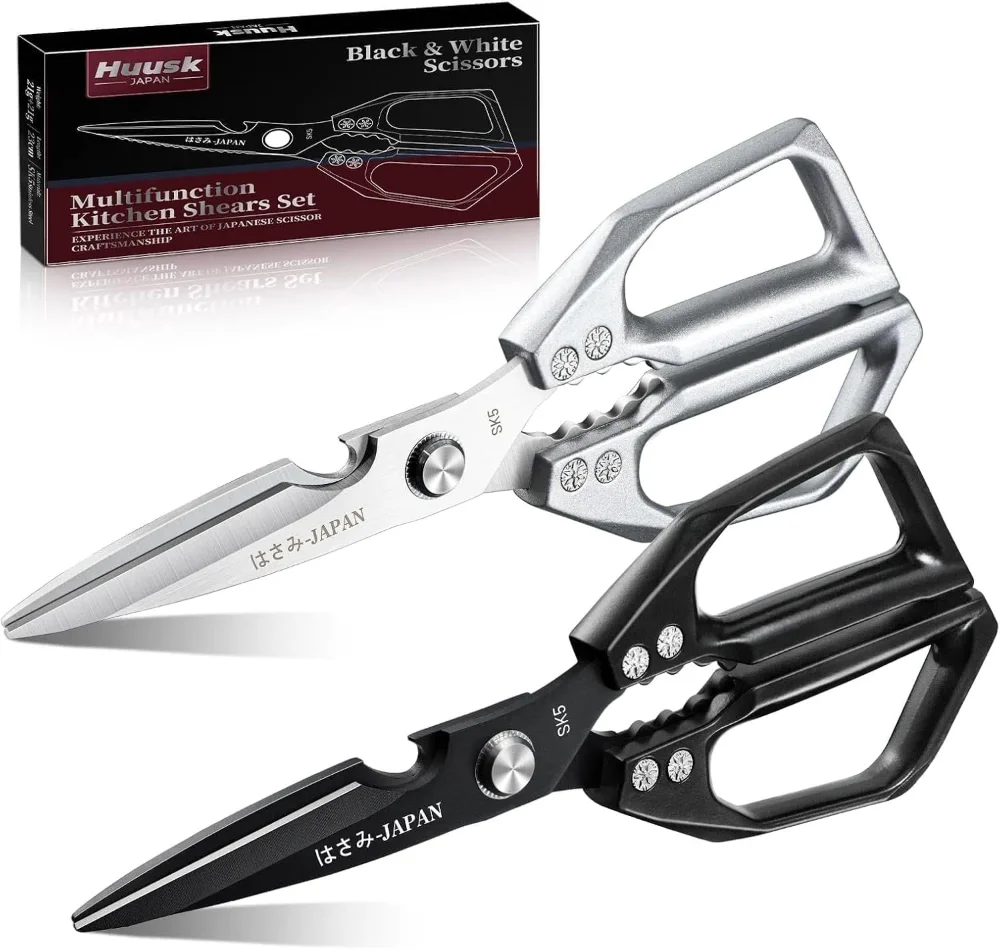
All purpose kitchen shears
4.6 · 778 ratings
10A minute of steel
What a forged finish looks like when the camera gets near it: the dimples left by the hammer, the line where the bevel starts, and the join between tang and handle.
11Against the alternatives
There are only so many answers to a drawer full of dull blades, and most kitchens have tried two of them. Here they are side by side, including the ones that involve buying nothing at all.
| The answer | What it does well | What it costs you | Honest verdict |
|---|---|---|---|
| Sharpening the knives you own | Free if you already have a stone, and a good edge on a decent blade | Time, and a soft blade will not hold what you put on it | Do it first: half of all dull knives are fixable |
| A supermarket stamped knife | Cheap, light, replaceable, no guilt when it goes in the dishwasher | Stamped from sheet, thin at the spine, and the edge gives up fast | Fine as a spare, wrong as the one you reach for |
| A German forged chef knife | Heavy, tough, forgiving of bone and of neglect | A thicker grind wedges in dense vegetables, and the weight tires a small hand | The right knife if you cook mostly meat |
| A Japanese forged blade like Huusk | Thinner behind the edge, so it parts food rather than splitting it | Less forgiving of twisting, and carbon steel needs drying | The right knife if you cook mostly on a board |
| A block set, whatever the brand | One purchase, matching handles, somewhere to put them | You pay for blades you never use, and the block takes counter space | Worth it when the price per knife beats buying three singly |
The fourth row is where the Huusk catalogue lives, and the first one is worth trying before you spend anything at all.
12Standards, and what they cover
A kitchen knife is one of the least certified objects in an American house, and that is worth knowing before you weigh anybody’s promise about an edge, ours included.
ISO 8442 is the international standard family for cutlery in contact with foodstuffs, and Part 1 is written specifically for knives used to PREPARE food rather than to eat with. It was published in 1997, reviewed and confirmed in 2021, and is being revised now. It exists. It is not something a kitchen knife is routinely certified against.
International Organization for Standardization, technical committee ISO/TC 186, read August 29, 2026Part 5 of the same family specifies how sharpness and edge retention are measured: a blade is drawn against a card strip under a counterbalanced load and the amount of card cut is recorded, with an annex for calibrating the rig. Anybody claiming an edge in numbers should be able to say which method produced them.
International Organization for Standardization, prepared by CEN with ISO/TC 186, read August 29, 2026The Rockwell test is an empirical indentation test that may correlate with wear resistance and toughness. ASTM states plainly that a reading taken at one point on a part may not represent the whole part. That is why a single HRC number on a box is weaker evidence than it looks, and why there is not one printed on this site.
ASTM International, read August 29, 2026NSF/ANSI 2 sets minimum food protection and sanitation requirements for the materials, design and construction of food handling equipment in restaurants and commercial kitchens. It is the standard a professional kitchen buys against, and it is a certification a manufacturer either holds for a given product or does not.
NSF International, read August 29, 202613The small blades
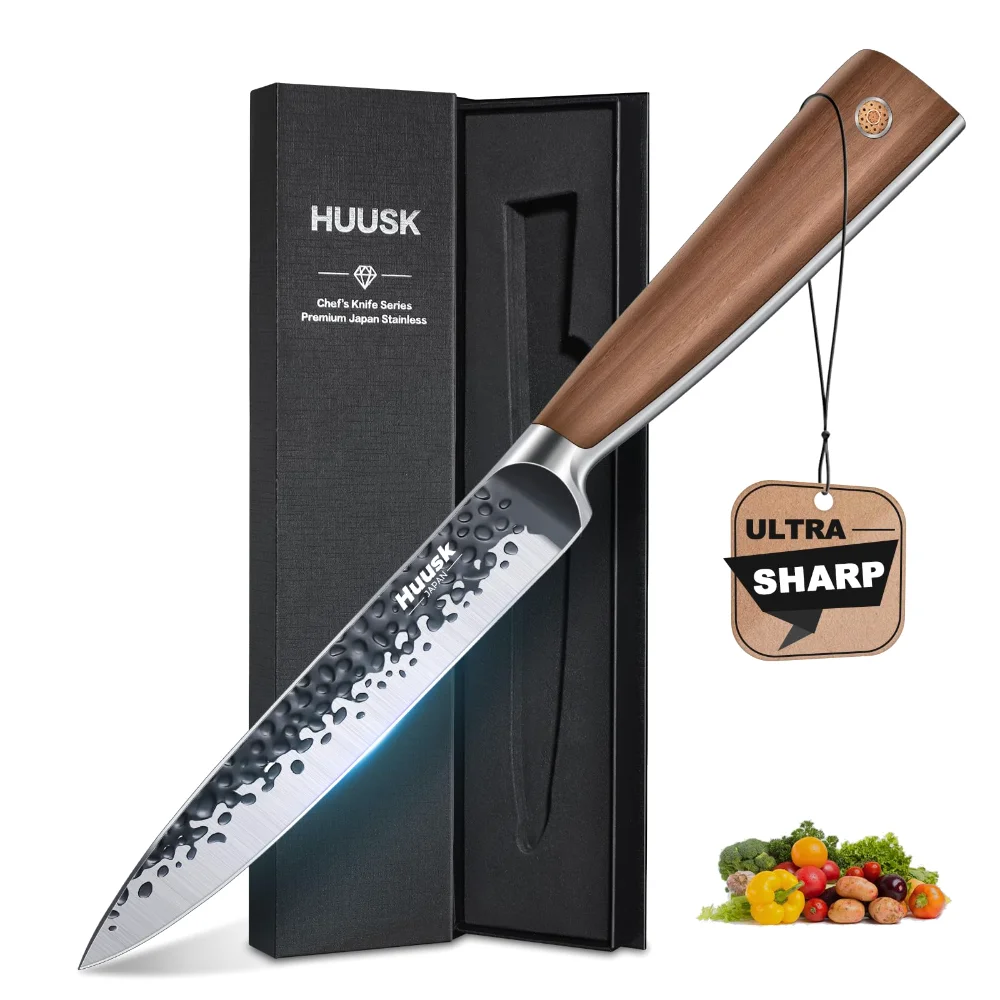
Paring, peeling and trimming: the short Huusk blades for the work you do holding the food rather than laying it down. They are the cheapest things on this site and the ones people say they use most.
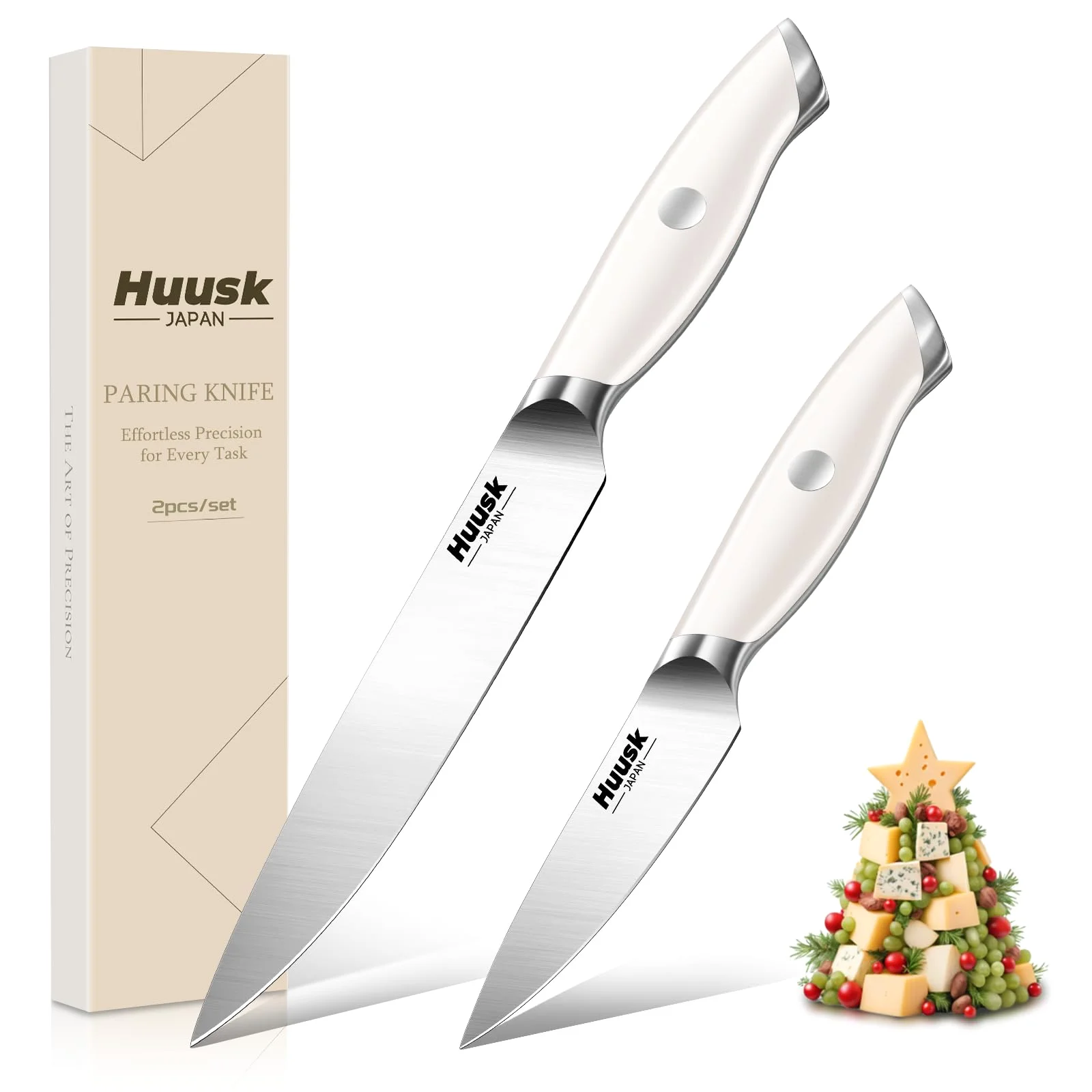
Utility knives
4.4 · 525 ratings
Utility knives
4.6 · 489 ratings
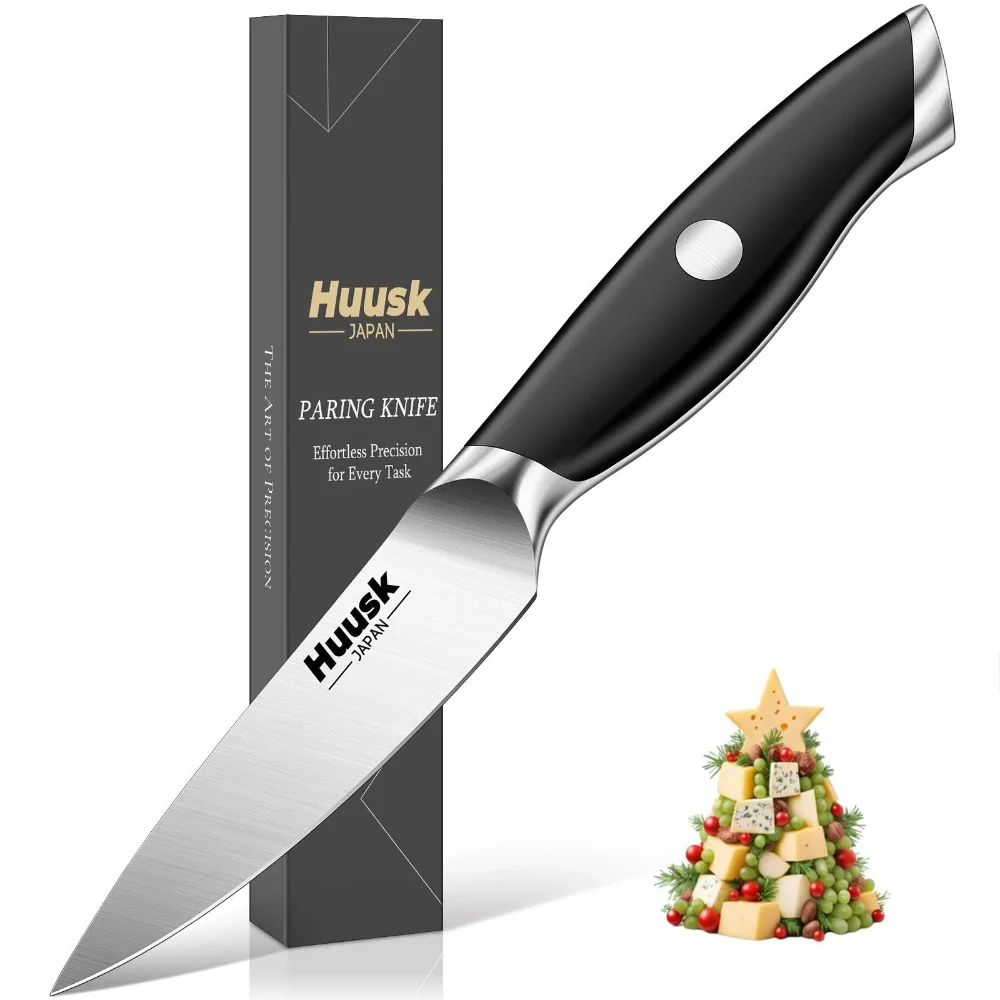
Paring knives
4.7 · 41 ratings
All 10 paring and utility knivesAll 20 folding and outdoor blades
14In their words
Nine buyers on what happened after the first month: the edge that wanted a whetstone out of the box, the carbon blade that has to be dried, the weight that took getting used to.
★★★★★
An 18 lb top sirloin
I used it to break down a whole top sirloin into individual steaks and it was amazing! The blade is super sharp and helped a lot cutting down this 18lb chunk of meat. For the price, you can’t go wrong!
★★★★☆
Carving a rotisserie chicken
Good knife, comfortable, beefy. The edge retention can be a bit hit or miss, as I find myself sharpening it more than some other of my knives. For its weight it’s surprisingly deft, allowing for precise cutting where you’d think this complete slab of a knife might not function. The handle is comfortable and you feel very much in control of your cuts. Can handle cutting through chicken bone SURPRISINGLY well (it’s a great knife for carving up a rotisserie chicken!). It’s been very durable in our use case, and overall it’s a good addition to the stable of knives we use on a regular basis. Only took a star off because trying to sharpen it is a bit unwieldy until you get familiar with it.
★★★★★
Hand washed, dried every time
Sharp as a razor. Chops, slices and cuts with ease due to the weight of the knife and blade. Can get a really good grip and control the blade well. The downside is that it is a high carbon blade for keeping a sharp edge and NOT stainless steel. The knife cannot go in the dishwasher and has to be washed by hand and dried thoroughly to prevent rusting later.
★★★★★
Outdoor cooking knives
I was skeptical on these knives being a decent quality. They aren’t as expensive as a “quality” set of knives. But to my surprise they came fairly sharp. They will cut right out of the box. Just not as sharp as I like a knife to be. A little time on the whetstone and leather strop and you can shave with them. They are my outdoor cooking knives. They get abused a little more than the wives kitchen knives. They hold an edge pretty well. They have a good weight to them, and a solid handle. Overall pleased with them.
★★★★☆
Tomatoes, then brisket
Good knife, just only issue was the edge didn’t hold up well and going from tomato’s to say a piece of brisket was challenging. I still use it but sharpen it every time before using
★★★★★
After three plastic-handled pairs
For the price, exactly what I was looking for. Far better than the last 3 pair of my standard black plastic handle ‘heavy duty’ kitchen scissors, that end up breaking within a couple of years. The last pair broke cutting a bouquet of flowers stems. These are heavy duty indeed, and incredibly SHARP out of the box, razor sharp that is! The handles are some sort of painted metal from what i can tell and look to last a long time. Slightly big and heavy but for what I am going to use them for, I am pleased. They also got fine in the knife butcher block slot that I have.
★★★★★
Reading the spine taper
1.The knifes build quality is very good, the spine is very thick at the back end and tapers down to a nice chopping V. 2 .the handle is solid wood, and held in place with three fasteners. 3.The Huusk has a grip ribbing at the back of the blade that keeps the knife from slipping. A knife has excellent weight
★★★★★
Heavier than she is used to
Wow, these are very sharp. I am very careful with knives and I managed to cut myself a little with the back end (point near the hilt) of the knife. My husband loves these too. They are pretty heavy, more so than I am used to.
★★★★★
Kept oiled between uses
Keeps an edge. Nice balance. Not dishwasher safe. I keep mine coated in cooking oil. I haven’t had any issues.
15The long version
A thousand words on forging, on what a steel name does and does not tell you, and on the nine shelves this catalogue has grown into. If you would rather have the short version, Huusk answers the same questions in six on its own page.
A Huusk knife, like every kitchen knife, is the one tool in a house you hold by the blunt end of a blade and push towards your own hand. Everything else about it, the steel and the pattern and the handle and the box, is downstream of that one fact, and so is everything below.
Most knives sold in the United States are stamped. A press cuts the outline out of a rolled sheet of steel, an edge is ground on, a handle is fitted, and the blade is roughly the same thickness from spine to bevel. That is a cheap knife to make and a perfectly reasonable object. It is also why a supermarket chef knife squashes a ripe tomato instead of slicing it. A blade of even thickness has to force the two halves of the food apart, and the force has to come from you.
A forged blade starts as a billet. It goes into a fire, comes out soft enough to move, and is drawn out under a hammer: thick at the spine where the strength is needed, thin behind the edge where the cutting happens. The dimples on the flat of a Huusk knife are the record of that, not a texture pressed on afterwards. When the shape is right the blade is quenched, which locks the steel hard, then tempered, which takes the brittleness back out. Skip the tempering and the edge chips on a chicken bone. Overdo it and the knife is blunt in a fortnight.
None of that is exotic. It is how knives were made for a thousand years before rolling mills existed, and it survives because the geometry it produces is better, not because it is romantic. What it costs is time and a person paying attention at four separate moments, which is the whole of the price difference between the two kinds of knife.
Huusk has been on the market since 2021. It began with one blade, the hand forged shape somewhere between a chef knife and a small cleaver with a finger hole through the heel, and that knife is still the one people arrive looking for. It is the reason the catalogue exists and the reason it grew.
It grew the way catalogues do when they are driven by complaints rather than by a plan. A chef knife that cannot get through a chicken back is the Sunday problem, and it became the cleaver shelf. A paring knife too big to work against a thumb is the weekday problem, and it became the small blades. A boning knife with no flex ruins a fillet, and that became a shelf of its own with the flex printed on the card. Nine shelves, one question asked nine different ways.
| Shelf | What it is for | Knives | Price range |
|---|---|---|---|
| Hand forged Japan knives | The hand forged line the brand is known for | 12 | $24.99 – $143.99 |
| Chef, gyuto & santoku | The blade that does most of the work on a board | 31 | $20.02 – $60.47 |
| Butcher knives & cleavers | Bone, joint and the heavy grinds | 58 | $19.99 – $138.99 |
| Boning, fillet & trimming | Narrow blades that follow a shape rather than cut a line | 23 | $19.44 – $62.98 |
| Paring & utility knives | Short blades for the work done in the hand | 10 | $12.29 – $29.99 |
| Steak knives & table | Full tang knives that live on a laid table | 13 | $14.99 – $81.59 |
| Kitchen shears & scissors | Two blades, for the jobs where food will not lie flat | 22 | $12.99 – $133.59 |
| Knife sets, blocks & storage | Multi-piece boxes, blocks, rolls and sharpeners | 44 | $23.08 – $149.99 |
| Outdoor, folding & hunting | Folding, ulu and fixed blades that leave the kitchen | 20 | $19.99 – $77.27 |
Today the range runs from $12.29 to $149.99, across 15 blade lengths from 2.7" to 12". 69 of the knives ship with a sheath, which matters more than it sounds: a forged edge loose in a drawer meets a spoon, and the first chip is the one nobody stops noticing.
The face of a knife is what you look at in a photograph. The geometry behind the edge is what the knife actually is.
Steel is where knife marketing goes wrong, because a steel name sounds like a specification and usually is not one. A grade tells you the recipe, not what a particular workshop did with it: the same VG-10 can be run soft and tough or hard and keen depending entirely on the heat treatment, and the heat treatment is the part nobody publishes.
So this catalogue prints the steel where our own product data names it and says nothing where it does not. 45 of the knives here carry a named steel: Damascus pattern, a VG-10 core, ATS-34, high carbon, plain stainless. The rest carry a blank in that row rather than a guess.
There is no hardness figure anywhere on this site either, and that is deliberate. The Rockwell test is an indentation test, and ASTM says plainly in the standard that a reading taken at one place on a part may not represent the whole part. A single HRC number stamped on a box is therefore weaker evidence than it looks, and printing one we had not measured would be worse than useless.
For most kitchens the decision is not which brand but which three knives. A chef or gyuto blade of seven to eight inches does perhaps eighty per cent of the work on a board. A paring knife does the work you do holding the food. A serrated or heavy blade does the two or three jobs the first two do badly, which means bread or bone. Everything else in this catalogue, ours included, is refinement on top of those three.
The second decision is about you rather than the knife: whether anybody in your house will dry a blade. High carbon steel takes the best edge here and rusts if it sits wet overnight. If the honest answer is that knives get left in the rack, buy the stainless or VG-10 version and be content. A rusted knife you resent is worse than a stainless one you use every day.
The third decision is where the knife will live, and it is the one people leave until after the parcel arrives. A forged edge in a drawer meets a serving spoon, and the chip that follows is a stone job rather than a rod job. Sixty-nine of the knives here ship with a sheath and the card says which. If the one you want does not, a magnetic bar costs less than the knife and takes ten minutes to put up.
Every price on this site comes from our own product data and is refreshed on a schedule. The page that describes that schedule says so in plain words and gives the date of the last pass. A knife with no live offer does not appear here at all, so the counts in the table above move between one update and the next.
Blade lengths, piece counts, steels and handle materials are read out of the same data rather than typed from memory, and where our data does not carry a figure, the card leaves the row out. That is the whole editorial rule, and it is also the reason this page has fewer adjectives in it than most brand pages you will read this year.
16What people look for
Each of these is a page of its own, built out of the catalogue: the pieces that match, their blade lengths, their handle colours and the price range across the lot.
The blade that does most of the work: eighty-two pieces from a six-inch everyday knife to a twelve-inch slicer, in seven named steels, with the piece count printed wherever one arrives in a box with others.
All 82, by blade length and colour →Eighty-two boxes, from a pair to fifteen pieces. Every card divides the price by the count, because a set is only a bargain when the arithmetic says so and an expensive block when it does not.
All 82, by blade length and colour →Fifty-six blades drawn out under a hammer rather than cut from sheet: the hammered flat, the full tang and, on most of them, the leather sheath that keeps the edge off everything else in the drawer.
All 56, by blade length and colour →Forty-seven blades for the work with a bone in it: seven to eleven and a half inches, several arriving as three- or eight-piece kits in a roll bag that goes to the barbecue and back.
All 47, by blade length and colour →Forty-one blades named in the Japanese tradition: gyuto, santoku, nakiri, kiritsuke and the forged cleaver that started the range, in four steels and seven blade lengths.
All 41, by blade length and colour →17Worth reading first
Choosing the blade for the work you actually do, keeping an edge once you have one, and the board underneath it. Three questions we get asked more than any others.
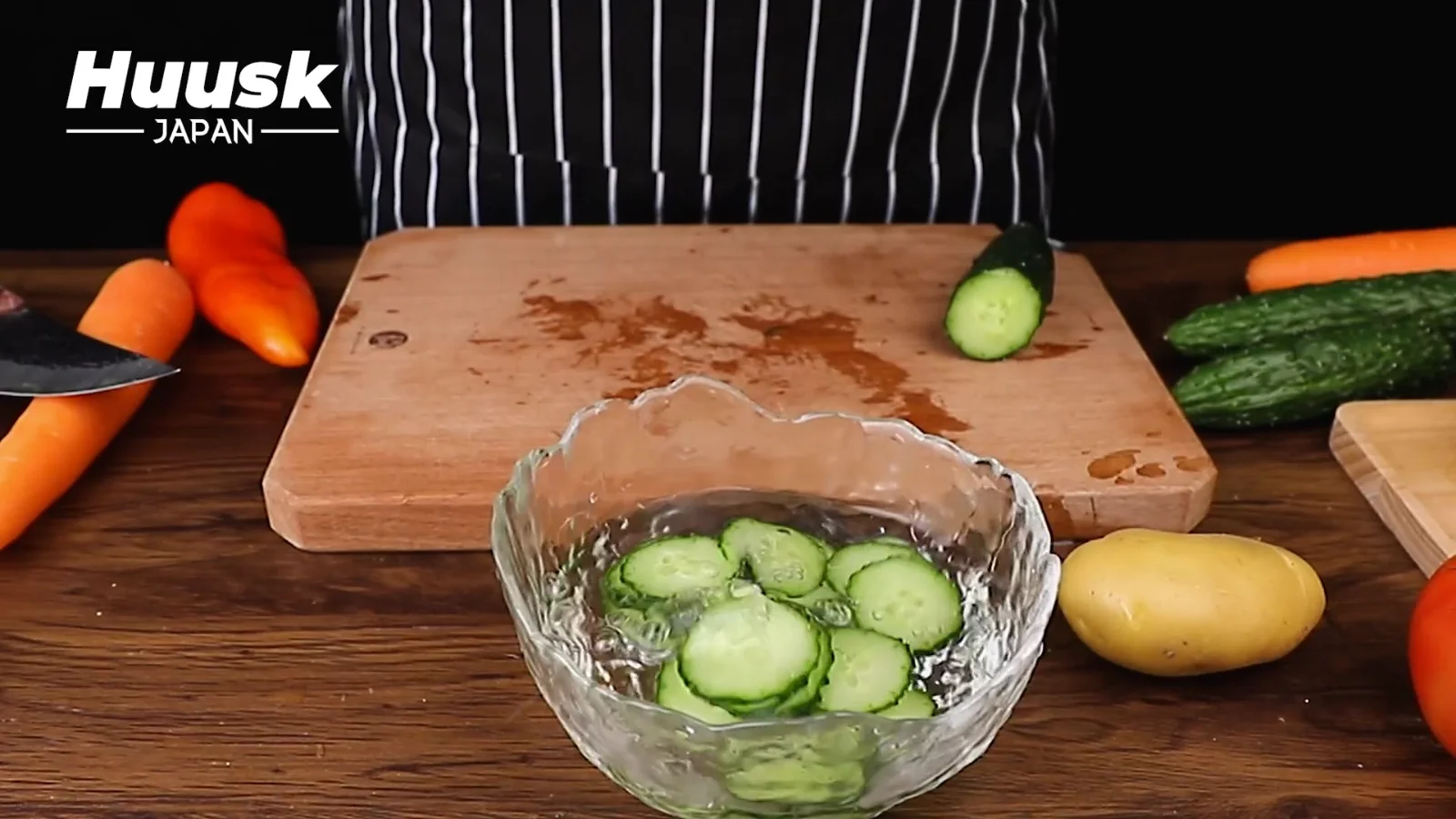
Most kitchens own eight knives and use two. Here is which two, at what blade length, and why the board you already own decides the answer before the steel does.
Read it →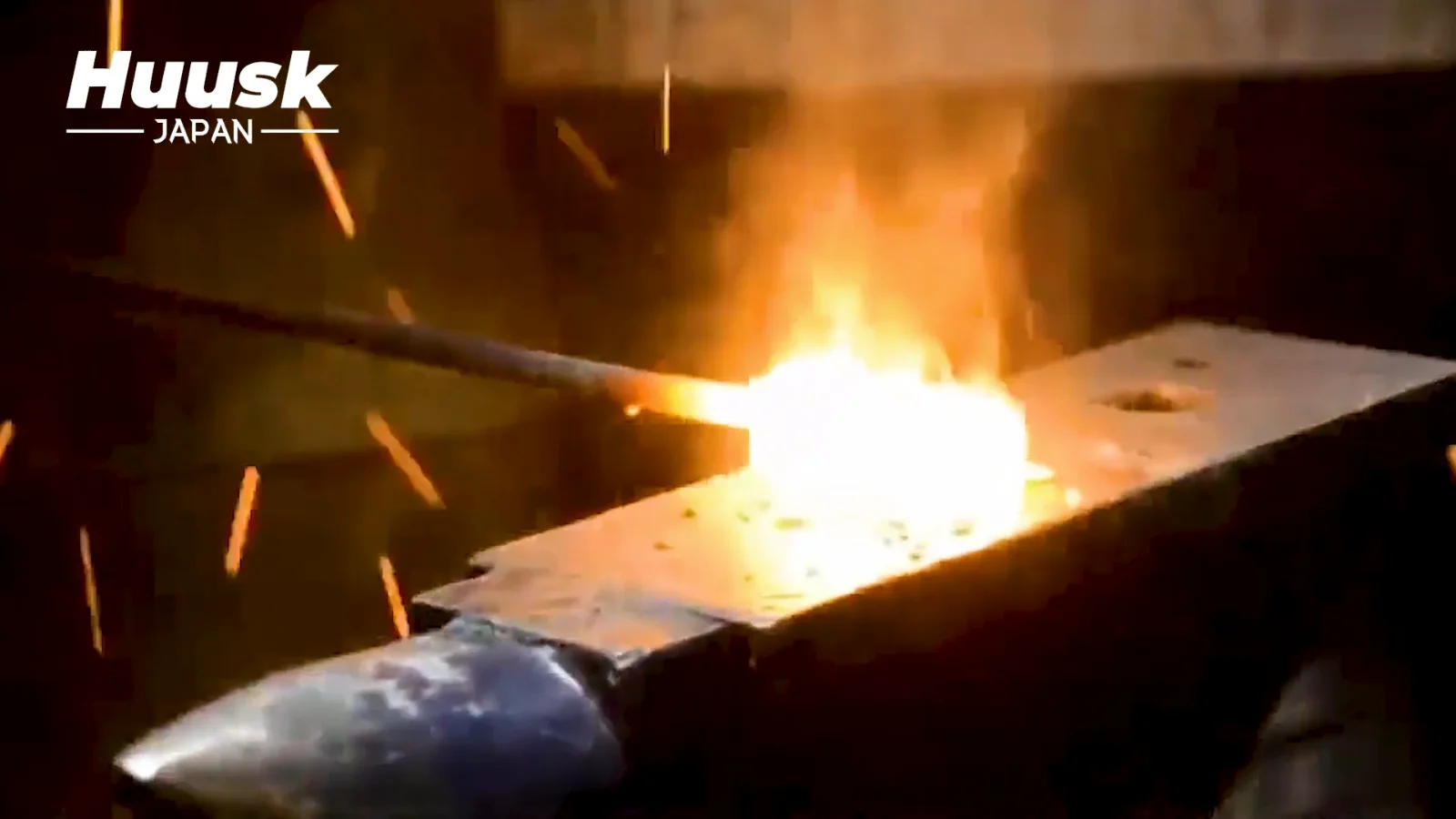
A knife that suddenly needs pressing is usually not blunt. The edge has rolled over to one side, and twenty seconds on a rod puts it back. Here is how to tell which of three things yours needs.
Read it →
A glass board will take the edge off a good knife in a fortnight, and a scarred plastic one is a food safety problem rather than a cutting one. What to buy, what to throw away, and what federal guidance actually asks for.
Read it →18Before you order
Blade length, washing, rust, sharpening, and where a Huusk order is actually placed.
Every card on this site carries a buying button, and every page has one at the bottom. The button opens the current price at our retail partner in a new tab. Payment, delivery and returns happen there rather than on this site.
If you already know the blade you want, the button in the header opens the whole range at once. If you do not, the nine shelves above narrow it down by the job the knife has to do.
Hand wash them, and dry them before they go away. That is not a warranty clause, it is what a dishwasher does: the detergent is abrasive, the rack knocks the edge against steel, and the drying cycle bakes water into the join between tang and handle.
It matters most for the high carbon blades, which will show rust spots after a single night wet. The stainless shears and steak sets survive a machine, and they still come out duller than they went in.
Measure the board you actually cut on. A blade longer than about two thirds of the board has nowhere to travel and ends up cutting at an angle to the food. On a twelve-inch board a seven-inch knife is right. An eight or nine wants fifteen inches or more.
Every card on this site prints the blade length, because a photograph of a knife tells you nothing about the size of the thing in your hand.
A high carbon blade will, if you let it sit wet. Carbon steel takes a keener edge than stainless and pays for it by reacting with water and acid, so an onion left on the blade overnight leaves a grey shadow.
The habit is thirty seconds long: wash it, dry it with a towel, put it away. If nobody in your house is going to do that, buy the stainless or VG-10 version instead and be honest about it. A rusted knife you resent is worse than a stainless one you use.
Most knives that feel blunt are not blunt: the edge has rolled over to one side, and a honing rod pushes it back straight in twenty seconds. Do that every few uses and you will sharpen properly two or three times a year instead of monthly.
When it really needs steel taken off, a whetstone at about fifteen degrees a side suits the Japanese blades here. The heavier butcher grinds take a wider angle and forgive a rougher stone. Pull-through carbide sharpeners work and take more metal than anything else on that list.
Divide the set price by the piece count and compare it against the two or three knives you would actually buy singly. Every set card on this site prints that figure beside the price, so the arithmetic is already done.
A fourteen-piece set is a bargain if nine of them get used and an expensive block if three do. Sets here run from two pieces to fifteen.
One button, the whole Huusk range
Every blade length, steel and piece count in the Huusk catalogue sits behind this button, with the current price beside it. Pick the job, check the blade against the board you own, and it ships from our retail partner.